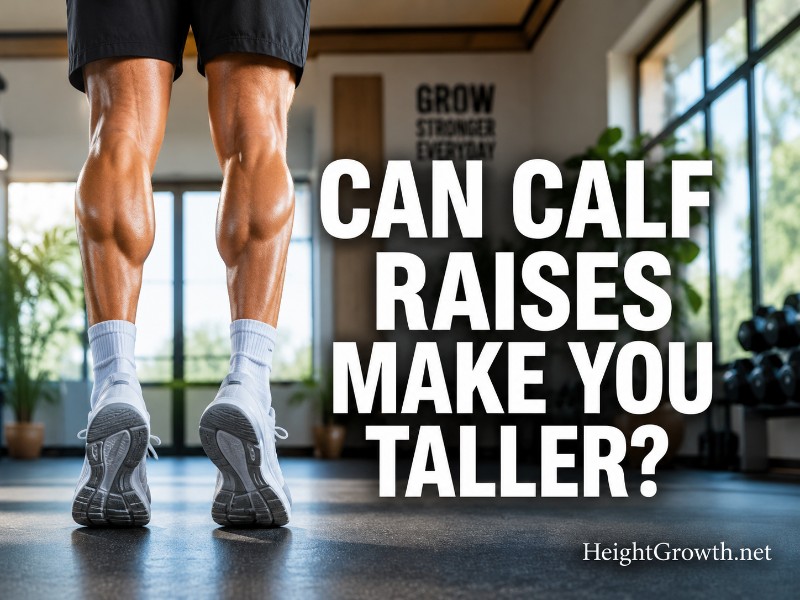
Somewhere between scrolling fitness TikTok and reading a late-night Reddit thread, you've probably stumbled across the claim that calf raises can make you taller. It sounds almost reasonable — you're literally pushing yourself upward, standing on the balls of your feet, fighting gravity rep after rep. The logic has a certain charm to it.
But here's what actually tends to happen when you dig into the science: the answer gets a lot less exciting, and a lot more useful.
This article breaks down what calf raises do and don't do for your height, how human growth actually works, and what evidence-based strategies exist for supporting healthy development. No hype. Just the biomechanics.
Can Calf Raises Make You Taller? The Short Answer
No, calf raises don't make you taller. Calf raises are a resistance training exercise that strengthens the gastrocnemius and soleus muscles of the lower leg. They don't lengthen bones, stimulate skeletal growth, or add permanent inches to your height. Once the growth plates in your long bones have closed — which happens for most people by age 18 to 25 — no exercise, calf raises included, will increase your actual stature.
That said, there's a more nuanced conversation worth having about looking taller, feeling more confident in your posture, and supporting growth during adolescence. Those are very different things, and they matter.
What Science Says
Exercise physiology is clear on this point: muscles adapt to resistance training through hypertrophy (getting bigger) and increased strength. Bones, on the other hand, grow in length only through a process called endochondral ossification — and that process requires open growth plates.
Calf raises target the gastrocnemius and soleus, the two primary muscles responsible for plantar flexion at the ankle. Strengthening them improves stability, athletic performance, and lower-leg endurance. None of that changes your skeletal height.
The confusion probably comes from the fact that standing on your toes during a calf raise temporarily makes you a couple inches taller in the moment. But that's just body positioning, not bone growth. It's the same reason high heels "work" — you're not growing, you're just elevating.
How Human Height Actually Increases
To understand why calf raises don't increase height, it helps to know how height actually develops in the first place.
The Role of Genetics
Roughly 60% to 80% of your adult height is determined by genetics. That's a wide range, and it accounts for things like inherited traits from both parents, ethnic background, and genetic variation within families. You've probably noticed that tall parents tend to have tall children, though not always — genetics aren't a perfect photocopy.
The remaining 20% to 40% comes down to environmental factors: nutrition, sleep, physical activity, and overall health during childhood and adolescence. That window matters a lot. But once you've reached skeletal maturity, the genetic blueprint has already been built.
Growth Plates and Puberty
Your long bones — the femur, tibia, and others — grow from regions called epiphyseal plates, or growth plates. These are zones of cartilage near the ends of bones where new bone tissue forms during childhood and puberty.
During puberty, hormones like growth hormone, estrogen, and testosterone drive rapid bone elongation. This is the growth spurt most people remember from middle school. Eventually, those same hormones trigger the growth plates to undergo ossification — they harden into solid bone and stop producing new tissue.
For most females, growth plates close between ages 14 and 16. For most males, it's closer to 16 to 18, sometimes extending into the early twenties. After that point, the skeleton is done growing in length. Period.
No amount of calf raises, hanging from a bar, or taking supplements will reopen those plates.
What Calf Raises Actually Do
Just because calf raises won't make you taller doesn't mean they're not worth doing. They're actually a pretty underrated exercise in most training programs.
Muscles Targeted
Both muscles connect to the Achilles tendon and control plantar flexion — the motion of pointing your toes downward. Strengthening them improves ankle stability, reduces injury risk, and gives the lower leg a more defined appearance.
Performance Benefits
For athletes, strong calves are more than cosmetic. Basketball players rely on calf strength for vertical jump height. Runners need it for push-off power and shock absorption. Even in physical therapy settings, calf raises are a go-to exercise for rehabilitating Achilles tendon injuries and improving balance in older adults.
If you're training for any sport that involves running, jumping, or quick direction changes, calf raises belong in your routine — just not because of height.
Can Exercise Make You Look Taller?
Here's where it gets interesting. You can't grow taller after your growth plates close, but you absolutely can appear taller through better posture and improved body composition. And the difference isn't trivial.
Better Posture Can Improve Your Appearance
Most adults lose anywhere from half an inch to two inches of visible height just from poor posture. Slouching, forward head position, rounded shoulders, and an anteriorly tilted pelvis all compress your frame and make you look shorter than your skeleton actually allows.
Exercises that strengthen the core, improve spinal alignment, and open up the chest can restore that lost height. Yoga, Pilates, deadlifts, rows, and planks all contribute. A physical therapist can assess your specific postural imbalances and recommend targeted corrections.
The result isn't "growing taller." It's standing at your actual full height — which, for a lot of people, turns out to be noticeably more than what they've been walking around at.
Stretching and Temporary Height Changes
Here's a fun piece of trivia: you're roughly 1 to 2 centimeters taller in the morning than at night. Throughout the day, gravity compresses the intervertebral discs in your spine, squeezing out fluid and reducing your height slightly. When you sleep and the spine decompresses, those discs rehydrate and expand.
Stretching, hanging, and spinal decompression exercises can temporarily restore some of that lost height during the day. But the keyword is temporary. The effect reverses as soon as you're upright and bearing weight again.
It's not growth. It's fluid dynamics. Useful to understand, but not something to build expectations around.
Height Growth Myths vs. Facts
The internet is full of height-growth claims, and most of them don't hold up under scrutiny. Here's how the most common ones stack up:
| Claim | Verdict | What's Actually Happening |
|---|---|---|
| Calf raises increase height | Myth | Strengthens muscles, doesn't lengthen bones |
| Hanging from a bar makes you taller | Mostly Myth | Temporarily decompresses spine, no permanent change |
| Jumping exercises add inches | Myth | Improves athleticism, not skeletal length |
| Height supplements work for adults | Myth | No supplement can reopen closed growth plates |
| Good posture makes you taller | Partially True | Restores lost visible height, doesn't add new growth |
| Sleep affects height in teens | True | Growth hormone is released during deep sleep |
| Nutrition impacts growth in children | True | Adequate protein, calcium, and vitamin D support bone development |
Common Internet Claims
Fitness influencers and supplement companies have a financial incentive to keep the "grow taller" myth alive. Anecdotal claims on social media — "these exercises added two inches to my height!" — almost always confuse posture improvement with actual bone growth. Or they're just flat-out fabricated.
The scientific evidence is consistent: after skeletal maturity, no exercise, supplement, or device will increase your height. What can change is how tall you carry yourself, and that's nothing to dismiss.
"You can't outwork your biology — but you can stop shortchanging the height you already have."
Healthy Ways to Support Growth During Adolescence
If you're a teenager or the parent of one, and the growth plates haven't closed yet, there are legitimate, evidence-based strategies for supporting healthy development.
Nutrition, Sleep, and Physical Activity
Nutrition
Adequate protein, calcium, and vitamin D give bones the raw materials they need during growth spurts.
Sleep
Growth hormone peaks during deep sleep. Teens need 8-10 hours for their bodies to develop as programmed.
Physical Activity
Weight-bearing exercise supports bone density and hormonal balance during the growth window.
Regular exercise doesn't "make" you grow taller, but it creates the conditions where your body can develop as it's genetically programmed to. And if there are concerns about a child's growth trajectory, a pediatric endocrinologist can evaluate growth hormone levels and bone age to determine whether medical intervention is appropriate.
Final Thoughts
Calf raises are a solid exercise. They build stronger calves, improve athletic performance, and contribute to ankle stability. What they won't do is add height to your frame.
The desire to be taller is understandable, and the fitness industry knows how to capitalize on it. But the biology doesn't bend to marketing. Once growth plates close, your skeletal height is set.
What you can control is posture, body composition, and overall fitness. Those things make a real, visible difference in how tall you appear and how you carry yourself — and that tends to matter a lot more in everyday life than a fraction of an inch on a tape measure.
Put your energy into what actually works. Your calves will thank you, even if your height doesn't change.
Pediatrician and public health specialist with expertise in child development, vaccination programs, and community health initiatives.
Board-certified endocrinologist with 14 years of experience specializing in diabetes management and metabolic disorders.