- 1.Key Takeaways
- 2.Does Running Make You Taller?
- 3.How Human Height Is Determined
- 4.How Running Affects the Body During Growth Years
- 5.Can Running Increase Height Before Puberty Ends?
- 6.Why Some People Feel Taller After Running
- 7.Running vs. Other Activities Associated With Height Growth
- 8.Habits That Support Healthy Height Development
- 9.Common Myths About Running and Height
- 10.Final Takeaway: Does Running Make You Taller?
If you’ve ever wondered whether lacing up your sneakers and hitting the pavement could add a few inches to your frame, you’re not alone. It’s one of those questions that floats around locker rooms, parenting forums, and youth sports communities constantly. Teenagers want to know. Parents want to hope. And somewhere in the middle, the truth gets a little blurry.
Here’s the honest answer upfront: running does not directly make you taller. Not in the way most people are imagining — longer legs, stretched bones, extra inches on the measuring tape. But that doesn’t mean running has nothing to do with how well your body grows. The relationship is more nuanced than a flat yes or no, and it’s worth understanding properly, especially if you’re in a growth phase or raising someone who is.
Running supports healthy development in real, meaningful ways. It just doesn’t work like a height cheat code.
Key Takeaways
- Genetics determines roughly 60–80% of your final height, according to research from the NIH.
- Running does not lengthen bones once growth plates have closed.
- During childhood and adolescence, regular aerobic exercise like running supports hormone balance, posture, and overall development.
- Sleep and nutrition contribute more directly to growth than any single exercise.
- Some people feel temporarily taller after running due to spinal decompression and posture improvements — but this isn’t permanent height gain.
Does Running Make You Taller?
Running won’t make your bones grow longer. That’s the straightforward answer, and it holds whether you’re talking about jogging, sprinting, or logging marathon-level miles. Once your growth plates close — usually sometime in your late teens — your skeletal frame is essentially set.
That said, running during childhood and adolescence does support the conditions your body needs to grow well. It stimulates growth hormone release. It improves circulation. It helps maintain the kind of healthy body composition that doesn’t put unnecessary strain on developing joints and bones. So running and height growth aren’t completely unrelated — the connection just isn’t direct.
Think of it like watering a plant. Water doesn’t create the plant’s size potential. That’s in the seed (genetics). But without consistent water, the plant won’t reach what it’s capable of. Running, during the growing years, is more like that water than most people realize.
How Human Height Is Determined
The Role of Genetics
Your genes set the ceiling. Most researchers estimate that genetic factors account for somewhere between 60% and 80% of final adult height, with studies from Nature Genetics and the NIH consistently supporting this range. Your parents’ heights, your grandparents’ heights, and the broader pattern across generations are the strongest predictors of how tall you’ll end up.
This doesn’t mean genetics is destiny in a rigid sense. Environmental factors — nutrition, sleep, physical activity, overall health during childhood — can either support or undermine what your DNA set out to do. But you can’t exercise your way past your genetic blueprint. That’s just not how skeletal development works.
Growth Hormones and Development
The pituitary gland produces human growth hormone (HGH), which directly stimulates bone and tissue development. Alongside HGH, a protein called insulin-like growth factor-1 (IGF-1) plays a major role — it’s released largely by the liver in response to HGH and drives the actual cellular growth in your bones and muscles.
These hormones are most active during childhood and puberty, and they’re heavily influenced by things like sleep quality, nutrition, and yes, physical activity. Aerobic exercise, in particular, has been shown to trigger short-term spikes in growth hormone levels. That’s a meaningful detail for growing kids and teens.
How Running Affects the Body During Growth Years
Running and Growth Hormone Production
Aerobic exercise like running creates a measurable hormonal response. Studies published in journals like the Journal of Clinical Endocrinology & Metabolism show that moderate-to-vigorous aerobic activity elevates growth hormone secretion — not just during exercise, but in the recovery period afterward. For teenagers whose bodies are already primed for growth, this kind of regular stimulation supports the hormonal environment that healthy development depends on.
This is different from saying running makes you taller. It’s saying running keeps the biological conditions favorable during the years when growth is actually happening.
Running During Childhood and Adolescence
Kids who are regularly active tend to have better bone density, healthier body composition, and stronger cardiovascular systems. The American Academy of Pediatrics recommends at least 60 minutes of moderate-to-vigorous physical activity daily for children and adolescents, and running fits cleanly into that.
What running won’t do is add height that genetics didn’t allow. But for a teenager in the middle of a growth phase, staying active — and running is excellent for this — creates the conditions where their natural growth potential gets the best chance to express itself.
Can Running Increase Height Before Puberty Ends?
Understanding Growth Plates
Growth plates, also called epiphyseal plates, are areas of cartilage near the ends of long bones where new bone tissue is produced. As long as these plates remain open, the bones can still lengthen. This process is what drives height increases during childhood and adolescence.
Running doesn’t directly stimulate growth plates to produce more bone. But physical activity does support the overall hormonal and circulatory environment that healthy growth plate function depends on. It’s indirect support — meaningful, but not the primary driver.
When Growth Stops
Growth plates gradually harden and fuse as adolescence progresses. For most girls, this happens between ages 14 and 16. For most boys, it’s a bit later — usually between 16 and 18, though some don’t fully close until 20 or 21. Once fusion is complete, bone elongation stops regardless of how much you run or exercise.
At that point, your adult height is essentially fixed. The conversation about running “making you taller” effectively ends there.
Why Some People Feel Taller After Running
This is where things get genuinely interesting — and where a lot of the running-equals-height myth probably comes from.
Posture and Height Perception
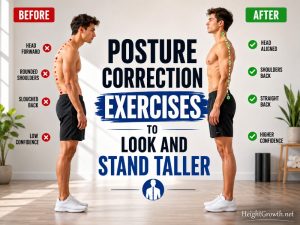
Running, especially when done consistently, strengthens the core and posterior chain muscles that support upright posture. When those muscles get stronger, people naturally stand with better alignment. Slumped shoulders pull back. The spine extends more fully. And the result is that someone can appear — and actually measure — slightly taller than they did before without any actual bone growth.
Posture alone accounts for roughly 1 to 2 inches of perceived height for many people. That’s not a trivial difference. It’s real and visible.
Spinal Decompression Effects
Throughout a typical day, gravity compresses the intervertebral discs in your spine. By evening, most people are measurably shorter than they were in the morning — usually by about half an inch. Running, counterintuitively, can temporarily relieve some of that compression by engaging the muscles that support spinal alignment and promoting the kind of movement that keeps discs hydrated and resilient.
So yes, you might stand a bit taller after a morning run. It’s not height growth. It’s your spine doing what it was meant to do when your body is in good condition.
Running vs. Other Activities Associated With Height Growth
There’s a lot of sports mythology around height. Basketball players are tall, so people assume basketball makes you tall. Swimmers have long torsos, so swimming must stretch the body. The reality is considerably less dramatic.
Here’s a comparison of commonly cited activities and what the evidence actually suggests:
| Activity | Common Claim | What Actually Happens |
|---|---|---|
| Running | Lengthens legs, adds height | Supports hormonal health, posture; no direct bone growth |
| Basketball | Jumping stretches the spine | Tall people are selected into basketball; the sport doesn’t create the height |
| Swimming | Elongates the body | Builds flexibility and posture; no evidence of bone elongation |
| Cycling | Lengthens the legs | Strengthens lower body; no skeletal lengthening effect |
| Strength training | Stunts growth in teens | No credible evidence of stunting when done appropriately; supports bone density |
Honestly, the pattern here is consistent. No sport or exercise creates height that genetics didn’t allow. What varies is how each activity affects posture, muscle balance, and hormonal health — all of which can influence how tall someone appears and how fully they develop during their growth years.
Does Basketball Make You Taller?
The association between basketball and height runs backward. Taller athletes are naturally drawn to, and selected for, basketball — not the other way around. Repeated jumping does create certain physiological adaptations, but bone elongation isn’t one of them.
Swimming and Height Myths
Swimming is excellent for flexibility, cardiovascular health, and building a long, lean physique. The elongated appearance of many competitive swimmers comes partly from body type (tall people with long limbs tend to be good swimmers) and partly from the flexibility and postural benefits the sport develops. It doesn’t stretch bones.
Habits That Support Healthy Height Development
If running alone won’t do it, what actually gives a growing child or teenager the best chance of reaching their full genetic height potential? A few things matter a lot more than most people expect.
Best Foods for Growing Kids and Teens
Nutrition is foundational. Protein provides the raw material for tissue growth — lean meats, eggs, legumes, and dairy all contribute. Calcium and vitamin D work together to support bone density and strength; the NIH recommends 1,300 mg of calcium daily for adolescents aged 9 to 18. Green vegetables, fortified foods, and dairy products are reliable sources.
Chronic nutritional deficiencies during childhood — particularly of protein, zinc, and vitamin D — are strongly associated with stunted growth. Getting adequate nutrition right is more important than any exercise routine.
Why Sleep Matters
This one genuinely surprises people. Growth hormone secretion peaks during deep, slow-wave sleep. The National Sleep Foundation notes that the body releases the largest pulses of HGH during the first few hours of sleep — making consistent, quality sleep one of the most direct ways to support healthy development.
Teenagers who consistently sleep fewer than 8 hours per night are working against their own growth process. A late-night phone habit can do more damage to height potential than skipping a run.
Common Myths About Running and Height
Myth: Running stretches the legs. Legs don’t stretch through exercise. Bone length is determined by growth at the epiphyseal plates, not by mechanical forces applied during movement.
Myth: Adults can grow taller through running. Once growth plates have fused, no exercise changes bone length. Adults can improve posture and appear taller, but actual height is fixed.
Myth: More running equals more height. There’s no dose-response relationship between running volume and height gain. Excessive running in adolescents can actually stress developing joints and, in extreme cases, disrupt hormonal balance.
The evidence here is clear and fairly settled in exercise science. The running-height connection, where it exists at all, is indirect — mediated through hormones, posture, and overall health.
Final Takeaway: Does Running Make You Taller?
Running is a genuinely excellent habit. It supports cardiovascular health, hormonal balance, bone density, posture, and mental well-being. For children and teenagers especially, it’s one of the better physical habits to build early.
But it won’t make you taller — not in the direct, bone-lengthening way the question usually implies. Your genetics set the ceiling. Sleep and nutrition are what most reliably determine whether you reach it. Running, during the growth years, helps create the conditions where everything else can work properly.
That’s a worthwhile role. It’s just a different one than the myth suggests.
If you’re raising a teenager who’s hoping running will add inches before their growth plates close, the best thing you can encourage is a full picture: move consistently, eat well, sleep enough. That combination gives the body what it needs. Running is a great part of it — just not the whole story.
Cardiologist and researcher with over a decade of clinical experience in heart disease prevention and cardiovascular risk reduction.
Fellowship-trained surgical oncologist specializing in minimally invasive procedures and cancer treatment protocols.

Frequently Asked Questions
People often assume more movement equals more growth, but your body doesn’t quite work like that. When you run during puberty, you’re supporting overall health—circulation improves, muscles stay active—but height comes down to growth plates and hormones doing their own timed job. You might feel “stretched out” after a good run, but that’s not actual bone length changing.
It’s tempting to think sprinting gives an edge. Faster, more intense, right? Still, neither sprinting nor jogging alters how long your bones grow. Sprinting may spike hormones briefly, but those short bursts don’t translate into added inches.
Growth usually slows and stops around 16–18 for females and 18–21 for males. Once growth plates close, that’s basically the cutoff.
After those plates close, height stays fixed. What changes, though, is posture—you stand straighter, look taller, but the skeleton itself doesn’t extend.
References
- National Institutes of Health (NIH) – Human Growth Hormone and Physical ActivityScholarly Article
- Mayo Clinic – Growth Plates: What Happens When They CloseScholarly Article
- Harvard Health Publishing – Exercise and Bone StrengthScholarly Article
- American Academy of Pediatrics (AAP) – Physical Activity and Adolescent DevelopmentScholarly Article
- Endocrine Society – Growth Hormone and Growth DisordersScholarly Article
- Journal of Clinical Endocrinology & Metabolism – Exercise-Induced Hormonal ResponseScholarly Article