Calcium gets all the credit. It’s the nutrient parents track, the ingredient on the back of every milk carton, the one that shows up in every “eat this for strong bones” headline. What rarely makes the list is the nutrient responsible for telling calcium what to do once it’s inside you.
That’s vitamin K2. And most Americans aren’t getting nearly enough of it from food.
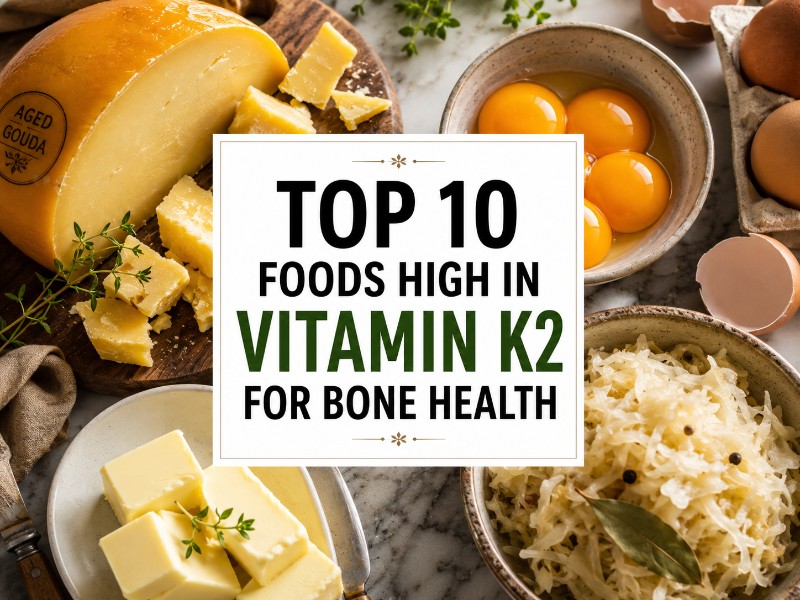
The top foods high in vitamin K2 are natto (fermented soybeans), aged cheeses like Gouda and Brie, egg yolks from pasture-raised hens, beef and chicken liver, grass-fed butter, and traditionally fermented sauerkraut. Natto contains far more MK-7 than any other food. The rest are realistic daily options for most US households.
Key Takeaways
- Vitamin K2 activates proteins that direct calcium into bones and away from arterial walls — something vitamin K1 doesn’t do nearly as well.
- Natto is the single richest food source of MK-7, the long-acting form of K2, but it’s an acquired taste with limited availability outside Asian markets.
- Aged fermented cheeses — especially Gouda — are the most practical everyday source of K2 for most Americans.
- There is no official Recommended Dietary Allowance for K2 specifically; it’s grouped under total vitamin K intake guidance.
- Pasteurized sauerkraut contains no meaningful K2; only refrigerated, live-culture versions even have a chance.
What Is Vitamin K2 and Why Is It Important for Bone and Heart Health?
Vitamin K2 is not the vitamin K in most multivitamins. That’s usually K1 — phylloquinone, the form abundant in leafy greens and primarily involved in blood clotting. K2 (menaquinone) has a different job, and understanding that difference is the whole point of this article.
Vitamin K2 vs. Vitamin K1
K1 comes from plant foods — kale, spinach, broccoli, vegetable oils. The body uses it quickly and efficiently for coagulation. It does not meaningfully activate the proteins responsible for calcium transport.
K2 comes from animal products and fermented foods. It exists in several subtypes, but the two worth knowing:
| Form | Found In | Half-Life | Best For |
|---|---|---|---|
| MK-4 | Eggs, chicken, butter, liver | Short | Broad tissue distribution |
| MK-7 | Natto, some fermented cheeses | Long (days) | Sustained bone and vascular effect |
MK-7 stays active in the bloodstream for days rather than hours, which means smaller, less frequent amounts can maintain useful levels. MK-4 is present in more everyday foods but clears quickly — which is why it shows up in higher doses in supplement research.
The practical upshot: eating varied animal foods and some fermented foods covers both forms.
How Vitamin K2 Supports Bones and the Heart
K2 activates two proteins that calcium metabolism depends on. The first is osteocalcin, which binds calcium into bone matrix. The second is Matrix Gla Protein (MGP), which prevents calcium from depositing in arterial walls and soft tissue.
Without enough K2, these proteins remain inactive — the technical term is “uncarboxylated.” Calcium absorbed from food has to go somewhere. If osteocalcin isn’t directing it into bone, and MGP isn’t blocking arterial calcification, the routing problem becomes obvious.
This mechanism is why K2 has attracted serious research attention for both osteoporosis and cardiovascular health. The bone evidence is further along, particularly in postmenopausal women. The cardiovascular data is promising but still developing. [VERIFY: cite recent meta-analysis on K2 and arterial calcification]
For adolescents in active growth phases, K2 matters alongside the better-known vitamins for height growth like vitamin D and calcium. The triangle of calcium + vitamin D + K2 is where the bone-building biology actually runs.
Top 10 Foods High in Vitamin K2 for Bone and Heart Health
Quick reference before the breakdown:
| Food | Primary K2 Form | Practical Availability |
|---|---|---|
| Natto | MK-7 | Asian grocery stores, frozen |
| Gouda cheese | MK-4 + MK-7 | Most US supermarkets |
| Brie cheese | MK-4 + MK-7 | Widely available |
| Egg yolks (pasture-raised) | MK-4 | Specialty grocery, farmers markets |
| Beef liver | MK-4 | Butchers, some grocery stores |
| Chicken thighs | MK-4 | Everywhere |
| Chicken liver | MK-4 | Most grocery stores |
| Grass-fed butter | MK-4 | Whole Foods, Costco, Target |
| Edam / Jarlsberg | MK-4 + MK-7 | Most supermarkets |
| Sauerkraut (live culture) | MK-7 | Refrigerated section only |
1. Natto (Highest Natural Source)
Nothing else comes close. Natto is fermented soybeans — specifically, soybeans fermented with Bacillus subtilis natto, the organism that synthesizes MK-7 during fermentation. Plain soybeans contain almost none. The process is what makes it extraordinary.
[VERIFY: current best available figure for MK-7 content per 100g natto from NIH ODS or USDA FoodData Central]
The taste is not subtle. Sticky, intensely savory, slightly pungent — it’s a Japanese breakfast staple eaten over rice. In the US, it’s available in the frozen section of Japanese and Korean grocery stores, often packaged in small individual styrofoam containers.
If the flavor works for you, a few servings a week would place your K2 intake well above most other dietary approaches. It’s also inexpensive. The barrier is entirely palatability, not cost or access.
2. Gouda Cheese
Gouda is the most K2-rich cheese you’re likely to find at a regular US supermarket, and it’s there because the bacterial fermentation involved in aging continues to develop menaquinone compounds over time. Aged Gouda contains more than young Gouda for exactly that reason.
[VERIFY: comparative MK-7 content aged vs. young Gouda from published dairy analysis]
It’s carried at Costco in multi-pound blocks, at Trader Joe’s in several aged varieties, and at virtually every mainstream grocery chain. There’s no specialty sourcing required. A few slices a day adds up to meaningful cumulative intake without any real effort.
3. Brie Cheese
Brie gets its character from mold-ripened aging — the white rind is the result of Penicillium camemberti cultures, which produce K2 compounds during maturation. The rind is edible and contains nutrients. Cutting it off is nutritionally unnecessary and, frankly, a missed opportunity at the cheese board.
Soft cheeses like Brie tend to have less K2 per gram than hard aged cheeses, but they’re still a meaningful source. And most Americans are already eating them at some point. This is the kind of food where the health case is a pleasant bonus rather than a hard sell.
4. Egg Yolks
The entire K2 content of an egg lives in the yolk. The white contributes essentially nothing here — which is worth knowing if you’ve been defaulting to egg whites for nutrition reasons.
Pasture-raised eggs consistently show higher levels of fat-soluble vitamins, including K2, than conventional eggs. The difference comes from diet: hens grazing on grass and insects accumulate more fat-soluble nutrients than hens eating grain-only feed. “Free-range” and “cage-free” labels don’t reliably indicate grass access. “Pasture-raised” does. [VERIFY: comparison of K2 content pasture-raised vs. conventional eggs]
The extra cost — usually $1–3 more per dozen — reflects a real nutritional difference, not just marketing.
5. Beef Liver
Beef liver is, calorie for calorie, one of the most nutrient-dense foods available. K2 is one of several fat-soluble vitamins concentrated there alongside vitamin A, B12, iron, and folate.
The serving guidance matters. Organ meats are high in preformed vitamin A (retinol), and excessive intake over time can cause toxicity. A 3-ounce serving once or twice a week is the range most recommendations land in. This is not a food to eat daily in large amounts.
Grass-fed liver has a cleaner, less intense flavor than conventional. Most butcher shops carry it; Whole Foods and some Sprouts locations stock it as well. People who’ve written off liver based on a childhood memory may want to give a good preparation — quickly seared, not overcooked — another look.
6. Chicken Thighs
Dark poultry meat has more fat than white meat, and fat-soluble vitamins travel with dietary fat. Chicken thighs outperform chicken breast on K2 content for that reason alone — not because of anything exotic about the animal, just basic nutritional architecture.
They’re also one of the most budget-friendly protein options available and hold up well to almost any cooking method. Baked, roasted, slow-cooked, grilled — K2 content isn’t meaningfully affected by preparation. Among the foods that help you grow taller during adolescence, affordable, high-nutrient proteins like this deserve more attention than they typically get.
7. Chicken Liver
Chicken liver edges out chicken thighs on K2 per serving, is higher in iron and B vitamins than muscle meat, and costs less than almost any other animal protein at most US grocery stores. The case for it is almost annoyingly strong.
The flavor is milder than beef liver. Overcooked chicken liver turns chalky and grainy — that’s where the bad reputation comes from. Cooked quickly in a hot pan with butter and fresh herbs, the texture is entirely different. Pâté is an easy entry point for skeptics; it’s available pre-made at most grocery delis.
8. Butter from Grass-Fed Cows
Grass-fed butter contains more MK-4 than conventional butter because the cows spent meaningful time on pasture. The K2 content tracks with how much fresh grass was in the animal’s diet — a fully pastured cow in peak grazing season produces dairy with measurably higher fat-soluble vitamin content than one eating mostly silage or grain. [VERIFY: seasonal variation in K2 content of grass-fed dairy]
Kerrygold is the most widely available brand in the US sourced from predominantly grass-fed herds — stocked at Costco, Target, and most major chains. It’s not a high-K2 food by itself, but if you’re already using butter, this is a zero-effort upgrade that contributes to cumulative daily intake.
9. Hard Cheeses (Edam and Jarlsberg)
Edam and Jarlsberg won’t generate excitement. They’re the practical backup options — firm, mild, widely available, and useful at the everyday level where most nutrition actually happens.
Both are aged fermented cheeses that produce MK-4 and some MK-7 during maturation. Neither reaches Gouda levels, but both are solid everyday contributions. Sliced for sandwiches, cubed for snacks, added to a lunchbox — these are the cheeses that quietly do their job without requiring any particular intention.
10. Sauerkraut (Traditional Fermented Versions)
The asterisk on sauerkraut is significant. K2 content depends on which bacterial strains were active during fermentation, and most commercial sauerkraut in the US has been pasteurized — meaning the cultures are dead and MK-7 production stopped before the jar hit the shelf.
The rule is simple: refrigerated sauerkraut with “live cultures” or “raw” on the label. Shelf-stable sauerkraut in cans or jars kept at room temperature does not qualify. Even with the right product, K2 levels are variable and generally lower than fermented dairy.
The gut health benefits from live-culture fermented vegetables are real and independently worth pursuing. The K2 contribution is a secondary benefit, not a primary reason to add sauerkraut to your diet.
How Much Vitamin K2 Do You Need?
There is no official Recommended Dietary Allowance specifically for K2. The NIH’s Adequate Intake (AI) for total vitamin K is 120 mcg/day for adult men and 90 mcg/day for adult women — but this figure primarily reflects K1 intake from vegetable sources and does not map directly to K2 needs.
Research trials using K2 for bone outcomes have used a wide range — from 45 mcg/day of MK-4 to 180 mcg/day of MK-7 — which is substantially higher than what most Americans consume from food. [VERIFY: dosage ranges from NIH Office of Dietary Supplements K2 fact sheet]
That gap between official guidance and research doses exists because K2 was studied as part of total vitamin K for most of the past century, not independently. The science on K2 specifically is relatively recent, and dietary guidelines haven’t caught up yet.
For most healthy adults eating a varied diet that includes aged cheese, eggs, and some animal products, food-first intake is achievable. If you have osteoporosis or significant cardiovascular risk factors, whether supplementation makes sense is a conversation worth having with a physician — not a self-diagnosis situation based on an article.
Tips for Adding More Vitamin K2 Foods to Your Diet
Easy Meal Ideas
The goal isn’t a diet overhaul. It’s building consistent exposure across the week.
- Breakfast: Scrambled eggs from pasture-raised hens; toast with grass-fed butter; natto over rice (if you’ve made the leap)
- Lunch: Gouda on a sandwich or with crackers; Jarlsberg cubes as a snack
- Dinner: Baked chicken thighs; beef or chicken liver once a week
- Sides and snacks: Brie with whole-grain crackers; refrigerated live-culture sauerkraut as a condiment
Most of these involve swaps rather than additions — pasture-raised eggs instead of conventional, grass-fed butter instead of standard, aged Gouda instead of American. The behavioral change is minimal.
Shopping Tips
Whole Foods Market — reliable stock of pasture-raised eggs, grass-fed butter (Kerrygold and house brands), aged European cheeses, and refrigerated fermented vegetables.
Costco — Kerrygold butter in bulk at lower per-unit cost; aged Gouda available in larger portions.
Trader Joe’s — consistently carries a rotating selection of European-style aged cheeses; refrigerated sauerkraut and kimchi available.
Walmart — Kerrygold butter increasingly available; pasture-raised egg selection depends on location.
Asian grocery stores — the best source for natto, typically sold frozen in individual packs in the frozen section.
Frequently Asked Questions About Foods High in Vitamin K2
Which food has the most vitamin K2?
Natto, by a significant margin over everything else. A single serving contains more MK-7 than most Americans consume in a week from all other food sources combined. The only barrier is taste and familiarity — nutritionally, it’s in a category by itself.
Can you get enough vitamin K2 from food alone?
For most healthy adults eating a varied diet that includes aged cheese, eggs, and some animal products, yes. A diet that excludes most fermented and animal foods makes meaningful K2 intake harder to achieve through food alone — natto is the primary whole-food option for plant-forward eaters, though it’s not plant-based.
Is vitamin K2 safe if you take blood thinners?
This requires a direct conversation with your prescribing doctor before you change anything about your diet. All forms of vitamin K interact with warfarin (Coumadin) by affecting clotting factor synthesis, and changes in K intake can shift your INR in either direction. The interaction is manageable, but it requires monitoring and professional guidance. Do not make a dietary decision on this based on a general article.
Which cheese has the most vitamin K2?
Aged Gouda is consistently ranked among the highest in published analyses. The aging process matters — longer-fermented hard cheeses generally accumulate more K2 than fresh or mildly aged varieties. Fresh mozzarella, cream cheese, and cottage cheese have very little by comparison.
Are fermented foods always high in vitamin K2?
No. K2 production depends on specific bacterial strains, and not all fermentation produces meaningful menaquinones. Yogurt contains very little K2 despite being fermented. Kimchi levels vary. Refrigerated sauerkraut with live cultures may contain some MK-7, but it’s not consistent or high. Fermented dairy — particularly aged hard cheeses — is the most reliable plant-adjacent K2 source outside natto.
Pediatrician and public health specialist with expertise in child development, vaccination programs, and community health initiatives.
Research dietitian and nutrition scientist focused on evidence-based dietary interventions for chronic metabolic conditions.