- 1.Key Takeaways
- 2.Does Magnesium Make You Taller?
- 3.What Determines Your Height?
- 4.How Magnesium Supports Healthy Growth
- 5.Can Magnesium Help Children and Teenagers Grow Normally?
- 6.Can Adults Grow Taller by Taking Magnesium?
- 7.Signs of Magnesium Deficiency That May Affect Overall Health
- 8.Best Food Sources of Magnesium
- 9.Should You Take Magnesium Supplements for Growth?
- 10.Frequently Asked Questions About Magnesium and Height
- 11.Final Thoughts
Every few months, a new mineral becomes the thing parents are convinced their kid needs more of. Right now, magnesium is having a moment. And the question “does magnesium make you taller?” gets Googled constantly — by teenagers, by parents of picky eaters, by adults who’ve convinced themselves there’s still time.
The honest answer is more interesting than a flat yes or no. Magnesium won’t add inches to your frame. But if you or your kid is running low on it, the downstream effects on bone development, sleep quality, and muscle function are real — and during a growth window, those things matter more than most people realize.
Direct answer: Magnesium does not directly increase height. It cannot stimulate bone elongation or override your genetic ceiling. What it does is support the biological environment where normal growth happens — including bone mineralization, muscle recovery, and the deep sleep that triggers growth hormone release. Fixing a deficiency removes a genuine obstacle to growth. Supplementing on top of adequate intake adds nothing to your stature.
Key Takeaways
- Magnesium supports bone density, sleep quality, and muscle function — none of which directly adds height, but all of which matter during growth spurts.
- Genetics explain roughly 80% of your final height, according to a landmark review (Silventoinen, 2003). Magnesium operates in the remaining 20% — and only if you’re actually deficient.
- Growth plates close at the end of puberty. After that, no mineral — magnesium included — changes your adult height.
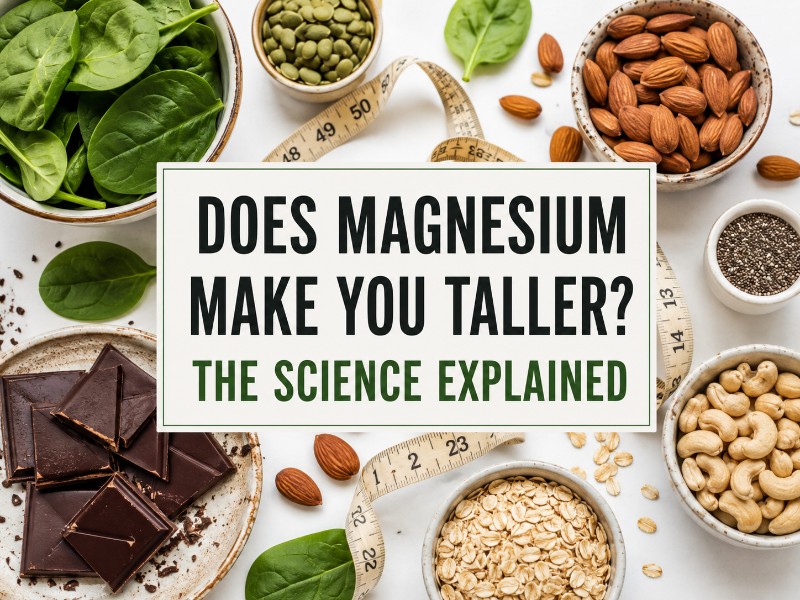
- The best source of magnesium is food, not supplements. Pumpkin seeds, almonds, spinach, and black beans cover most of the daily requirement without any of the digestive side effects supplements can bring.
- If your child is consistently tired, cramping frequently, or eating a narrow diet, magnesium deficiency is worth discussing with a pediatrician — not because it’s a height fix, but because it affects overall health.
Does Magnesium Make You Taller?
No — but the reason it keeps showing up in height conversations is worth unpacking.
Magnesium is involved in over 300 enzymatic reactions in the body. It plays a role in bone mineralization, protein synthesis, and the regulation of calcium and vitamin D — all nutrients associated with skeletal development. So the association makes intuitive sense. If magnesium is doing so much backstage work, shouldn’t more of it mean better growth outcomes?
The problem is confusing “supports normal growth” with “accelerates growth.” They’re different things. Magnesium helps the system run properly. It doesn’t push the system past its set point.
Think of it this way: a car with low oil pressure runs poorly. Topping off the oil gets it back to normal. But adding extra oil above the full line doesn’t make the car go faster.
What Determines Your Height?
Genetics Plays the Biggest Role
Height is predominantly inherited. Research from Silventoinen (2003) puts the genetic contribution at around 80% for people in developed countries — meaning the remaining 20% is where nutrition, sleep, and activity actually have room to move the needle.
The 2022 genome-wide study by Yengo et al. — the largest of its kind, analyzing 5.4 million individuals — identified more than 12,000 genetic variants associated with height, collectively explaining roughly 40% of the variation in height among people of European ancestry.
That’s a lot of genetic machinery. And it means that if short parents and tall children seem like a contradiction, it’s because inheritance is complicated — but the range you’re working within is mostly set before you’re born.
What nutrition does is determine whether you hit the top of that range or fall short of it.
Nutrition, Sleep, and Physical Activity
The environmental 20% isn’t evenly distributed. Nutrition does the heaviest lifting — a 2016 review in Nutrition Reviews found that it’s the most important external factor for linear growth, with protein and micronutrient intake during early childhood having the longest-lasting effects.
Sleep comes in close behind. Most of the body’s growth hormone is released during deep sleep — in concentrated pulses during slow-wave sleep, not gradually throughout the day (Shaw et al., 2023). Disrupted or insufficient sleep genuinely reduces growth hormone output in children. For teenagers trying to grow, that window is not theoretical.
How to grow taller advice almost always circles back to the same three variables: eat enough protein and micronutrients, sleep 8–10 hours, and stay physically active. Magnesium fits into all three of those categories — indirectly.
How Magnesium Supports Healthy Growth
Magnesium and Bone Development
About 60% of the body’s magnesium is stored in bone. That’s not incidental — magnesium is directly involved in bone mineralization, and its relationship with calcium is a two-way street.
Magnesium helps regulate how calcium is deposited into bone tissue. It also activates vitamin D, which in turn governs calcium absorption in the gut. Pull magnesium out of that chain and the whole system gets less efficient. Vitamins for height growth — particularly vitamin D and calcium — are only as effective as the supporting minerals that enable them.
A 2025 meta-analysis published in Frontiers in Pediatrics (PMC11703972) confirmed that bone mineral density in adolescents responds meaningfully to both nutrition and exercise during the 10–19 age window. Magnesium is part of that nutritional picture, even if it’s not the headline mineral.
Magnesium’s Role in Muscle and Nerve Function
Magnesium governs muscle relaxation — literally. Calcium triggers muscle contraction; magnesium enables the release. Without adequate magnesium, muscles stay in a state of excess tension, which is why low magnesium is associated with cramping and poor recovery after exercise.
For growing kids and teenagers who are physically active, that recovery piece matters. Does stretching make you taller is a question with a nuanced answer, but healthy muscles and connective tissue definitely contribute to posture — and poor posture can suppress apparent height by an inch or more.
Magnesium also supports ATP production, which is the energy currency of every cell. During rapid growth phases, cellular energy demands spike. A kid who’s chronically fatigued and not exercising isn’t building as much bone and muscle as one who is.
Can Magnesium Help Children and Teenagers Grow Normally?
If a child is magnesium-deficient, correcting that deficiency can remove a genuine constraint on normal development. That’s different from claiming magnesium adds height — it removes a subtraction.
The catch is that deficiency in American children is more common than it should be. A 2021 study in Nutrients linked diet quality to height-for-age in US children, with diets heavy in soft drinks and high-fat processed foods associated with lower height outcomes. Those are also the diets lowest in magnesium.
So for a teenager eating mostly fast food and getting inadequate sleep, getting enough magnesium — alongside protein and height growth support and other nutrients — could genuinely help them reach the top of their genetic range rather than the bottom. That’s meaningful. It’s just not the same as growing extra inches beyond what their genes allow.
For a teenager already eating a balanced diet, adding magnesium supplements is unlikely to do anything noticeable for growth. The floor was already covered.
Can Adults Grow Taller by Taking Magnesium?
No. And this is worth being direct about, because a lot of supplement marketing is deliberately vague on this point.
Growth happens at the growth plates — the soft cartilage zones near the ends of long bones. During puberty, these plates are active. Hormones signal them to produce new cartilage, which then mineralizes into bone, lengthening the skeleton. When boys stop growing and when girls stop growing follows a predictable pattern tied to hormonal changes at the end of puberty — for most girls around ages 14–16, for most boys a year or two later.
Once those plates fuse, they’re done. No amount of magnesium, calcium, vitamin D, or growth hormone supplementation can reopen them. This isn’t a gap in the research — it’s settled biology.
What magnesium does for adults is support bone density, muscle recovery, sleep quality, and metabolic function. All of those things matter. None of them adds height.
Signs of Magnesium Deficiency That May Affect Overall Health
Magnesium deficiency is often called “the invisible deficiency” because it’s common and the early symptoms are easy to dismiss.
Common signs include:
- Muscle cramps or twitches, especially in the legs
- Persistent fatigue that isn’t explained by sleep habits
- Poor appetite or nausea
- Tingling or numbness
- Irregular sleep quality
Risk groups include picky eaters (particularly children), teenagers relying heavily on processed foods, athletes sweating out electrolytes regularly, and people with GI conditions that reduce mineral absorption.
None of these symptoms scream “height problem” — because they’re not. They’re general health problems. But for a child in a growth window, chronically low energy, poor appetite, and disrupted sleep add up to a worse growth environment.
Best Food Sources of Magnesium
The better argument for magnesium isn’t supplementation — it’s fixing the diet. These foods are high in magnesium and fit naturally into American eating patterns:
| Food | Serving | Magnesium |
|---|---|---|
| Pumpkin seeds (roasted) | 1 oz | ~156 mg |
| Almonds | 1 oz | ~80 mg |
| Spinach (cooked) | ½ cup | ~78 mg |
| Black beans (cooked) | ½ cup | ~60 mg |
| Whole wheat bread | 2 slices | ~46 mg |
| Avocado | 1 medium | ~44 mg |
| Brown rice (cooked) | ½ cup | ~42 mg |
The daily recommendation varies by age. Teenage boys need around 410 mg/day; teenage girls around 360 mg/day. Most American teens fall short — not because magnesium is hard to find, but because seeds, leafy greens, and legumes don’t show up much in the average teenage diet.
The fix is mostly about foods that help you grow taller in the broader sense — a diet with actual variety, not a targeted supplement.
Should You Take Magnesium Supplements for Growth?
Probably not, unless a deficiency has been confirmed or a doctor recommends it.
The National Institutes of Health sets the Tolerable Upper Intake Level for supplemental magnesium at 350 mg/day for adults. Above that, the most common side effects are gastrointestinal — loose stools, cramping, nausea. Magnesium oxide causes these most often; magnesium glycinate and magnesium citrate tend to be better tolerated and have higher bioavailability if supplementation is genuinely warranted.
For children and teenagers, don’t guess on dosage. A pediatrician can check magnesium levels through a blood test and give a specific recommendation if there’s a real deficiency to address.
The supplement industry markets magnesium in ways that imply height benefits. Those implications aren’t supported by evidence. A growing teen who sleeps 9 hours, eats enough protein, and gets regular physical activity will do more for their growth potential than any supplement stack.
Frequently Asked Questions About Magnesium and Height
Does magnesium increase growth hormone?
There’s an indirect connection, not a direct one. Growth hormone is primarily released during deep, slow-wave sleep (Shaw et al., 2023). Magnesium supports sleep quality by regulating the nervous system and reducing cortisol — so adequate magnesium may support the conditions under which growth hormone is secreted. But no clinical evidence shows that magnesium supplements directly stimulate the pituitary gland to produce more growth hormone. The relationship is sleep-mediated, not hormonal in a direct sense.
What vitamins and minerals help children grow?
The nutrients with the strongest evidence for supporting normal growth during childhood and adolescence are:
- Protein — the structural material for bone and muscle (protein and height growth)
- Calcium — primary mineral component of bone tissue
- Vitamin D — governs calcium absorption; deficiency is common in US children
- Zinc — involved in cell division and protein synthesis; low zinc is associated with stunted growth in developing countries
- Magnesium — supports bone mineralization and the metabolic functions that enable growth
These nutrients work as a system. A diet that hits adequate levels of all of them is more effective than megadosing any single one. The priority, especially for younger children, is a varied diet — not a supplement protocol.
Can magnesium deficiency stunt growth?
Chronic deficiency during childhood can contribute to what can stunt your growth — not because of magnesium specifically, but because deficiency impairs bone mineralization, disrupts sleep (and therefore growth hormone secretion), and reduces overall metabolic efficiency. Severe, prolonged deficiency is more likely to be an issue in populations with food insecurity than in average American households, but mild deficiency from poor diet quality is common enough to be worth addressing.
Should teenagers take magnesium supplements?
Only if a deficiency has been identified. For most teenagers, the better move is improving diet quality — more seeds, nuts, leafy greens, and whole grains. If a teenager is an athlete, has a very restricted diet, or shows signs of deficiency, talking to a doctor about testing and potential supplementation is a reasonable step. Self-prescribing supplements without testing first is mostly just expensive guesswork.
How long does magnesium take to affect growth?
There’s no timeline for magnesium “working” on height — because it doesn’t work on height directly. If a child was deficient and now has adequate levels, the improvements in bone density, sleep, and muscle function will develop over weeks to months. Whether any of that translates to a measurable difference in height depends on how deficient they were, how much of their growth window is left, and their underlying genetics.
Final Thoughts
Magnesium matters for health. During childhood and adolescence, it supports the systems that allow a growing body to reach its genetic potential — better bone mineralization, sounder sleep, more efficient energy use. Getting enough of it is genuinely worth caring about.
But it won’t make you taller than your genes allow. And after your growth plates close, it won’t do anything to your stature at all.
The most useful reframe: instead of asking “will this mineral make my kid taller,” ask “is my kid’s body getting what it needs to grow as well as it can?” That’s a question magnesium — alongside protein, sleep, vitamin D, and regular movement — actually helps answer.