- 1.Key Takeaways
- 2.What Is an Inversion Table?
- 3.Can an Inversion Table Actually Make You Taller?
- 4.What Scientific Studies Say About Height and Inversion Therapy
- 5.Why You're Taller in the Morning (and What Inversion Has to Do With It)
- 6.Potential Benefits of Inversion Therapy That Are Actually Supported
- 7.Risks and Who Should Skip Inversion Therapy
- 8.Other Ways to Appear Taller — That Actually Work
- 9.Choosing an Inversion Table in the U.S.
Walk through any fitness store and you’ll spot inversion tables — those tilting contraptions that hang you upside down like a bat. The marketing copy often nudges toward back pain relief, but search comment sections and Reddit threads long enough and you’ll find a different question buried underneath: can these things actually make you taller?
The honest answer is more interesting than either the enthusiasts or the skeptics usually let on.
Quick answer: An inversion table does not permanently increase your height. Research shows it can temporarily decompress spinal discs, producing a measurable but short-lived height gain — typically less than an inch — that disappears within minutes to hours of returning to upright. No published study demonstrates lasting height increases from inversion therapy in adults.
Key Takeaways
- Inversion tables work by temporarily reducing gravitational compression on the spine, not by stimulating bone growth.
- Any height gained after inversion is the same height you already have every morning — it disappears by evening.
- Scientific research on inversion therapy focuses on back pain and spinal loading, not height gain.
- Adults whose growth plates have closed cannot grow taller through any mechanical means, including inversion.
- The most evidence-backed benefits of inversion therapy are modest back pain relief and improved flexibility — worthwhile goals, just not the taller-you goal.
What Is an Inversion Table?
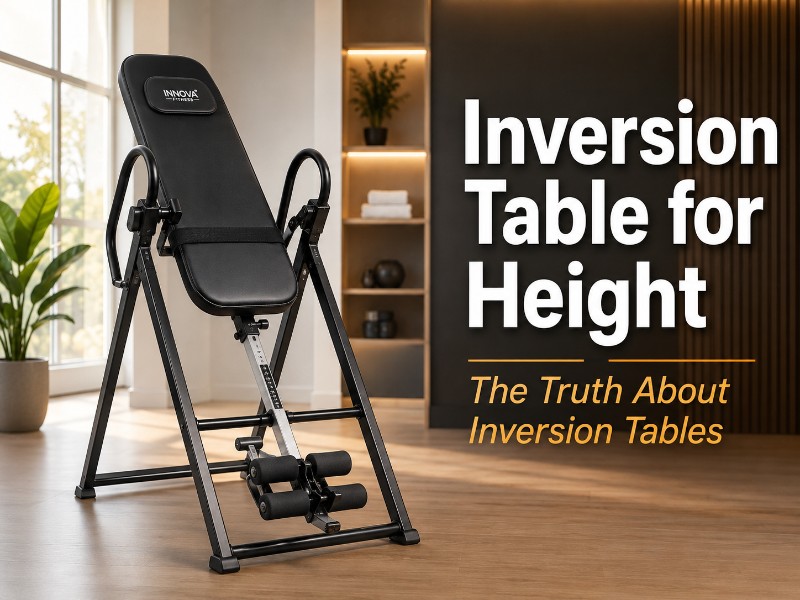
An inversion table is a padded, hinged platform that anchors your ankles and allows your body to tilt backward — anywhere from a slight 20-degree angle to a full 90-degree inversion. The goal is to flip the usual relationship between gravity and your spine.
Normally, gravity compresses your vertebrae together all day. An inversion table reverses that, using your own body weight as traction. The result is spinal decompression — the discs between your vertebrae get a chance to expand and rehydrate.
They’re widely sold in the U.S. and used in some physical therapy settings. Brands like Teeter, Ironman, and Innova dominate the market. They’re not fringe devices — they’re FDA-cleared wellness products, which matters for safety claims but doesn’t mean they do everything the marketing implies.
Can an Inversion Table Actually Make You Taller?
Short answer: temporarily, yes. Permanently, no.
Here’s what actually happens. Throughout the day, the intervertebral discs in your spine gradually compress under load. You lose a small amount of measurable height — typically around 0.5 to 0.75 inches — between when you wake up and when you go to bed. Inversion therapy, like lying flat or sleeping, allows those discs to re-expand. The height you “gain” from inversion is height you already had at 7 a.m.
This isn’t a knock on the therapy — it’s just physics. The spine is compressible. Reduce the compression, measure the spine, and you get a bigger number. Resume standing, and you return to baseline.
What inversion cannot do is stimulate bone growth. That’s controlled by growth plates — cartilaginous regions at the ends of long bones that gradually ossify during adolescence. Once they close, typically in the late teens for most people, no mechanical force changes your skeletal height. (Genetics account for roughly 60–80% of final adult height, and growth plates are the mechanism through which that genetic program runs.)
What Scientific Studies Say About Height and Inversion Therapy
This is where the online claims get ahead of the evidence.
The published research on inversion therapy is almost entirely focused on lumbar spine pain, disc herniation management, and muscular tension — not height. A systematic review of spinal traction techniques (which includes inversion therapy) generally finds modest short-term improvements in back pain symptoms, but the evidence quality is often rated low to moderate due to small sample sizes and short follow-up periods.
No randomized controlled trial has measured permanent height change as an outcome of inversion therapy. That absence matters. It doesn’t mean the research hasn’t been done and came back negative — it means the question hasn’t been treated as scientifically interesting, because the mechanism for permanent height gain simply isn’t there.
What studies do confirm is temporary disc decompression. The nucleus pulposus — the gel-like center of each intervertebral disc — absorbs fluid when pressure is removed. This fluid absorption is real, measurable, and clinically relevant for disc health. But it’s the same process that happens every night when you lie down to sleep.
If you want the mechanism explained plainly: inversion therapy is a faster version of sleeping. Same outcome, shorter timeline.
Why You’re Taller in the Morning (and What Inversion Has to Do With It)
Most adults are genuinely taller in the morning than at night — by roughly half an inch on average. This isn’t a myth or an exaggeration. It’s spinal physics.
During the day, axial loading (the force of gravity bearing down through your spine while you stand, sit, and move) gradually compresses the intervertebral discs. Fluid gets pushed out of the nucleus pulposus. The disc thins slightly. Repeat that across 23 discs in the spine and you get a measurable daily height fluctuation.
Overnight, lying horizontal removes that axial load. The discs rehydrate. Fluid returns. You wake up taller.
Inversion therapy mimics this process — and accelerates it. Ten to twenty minutes inverted can partially decompress the discs faster than lying flat for the same duration. So yes, if you measure your height right after inversion, you may get a reading slightly above your standing afternoon height. That’s real. And it’s gone within an hour of resuming normal activity.
The contrarian angle worth knowing: this temporary decompression may matter more for disc health than for height. Keeping discs adequately hydrated over years of loading might help preserve spinal flexibility and reduce injury risk. That’s a legitimate long-term benefit, just not the dramatic “grow 2 inches” outcome some sellers imply.
Potential Benefits of Inversion Therapy That Are Actually Supported
Back pain relief is the most consistently cited benefit — and the evidence here is real, if modest. Research on lumbar spinal traction (the clinical version of what inversion tables do at home) shows some short-term benefit for people with disc-related lower back pain and sciatica. Physical therapists sometimes incorporate inversion-style decompression as part of a broader treatment protocol.
| Claimed Benefit | Evidence Level | Verdict |
|---|---|---|
| Temporary height increase | Mechanistically explained | Real, but short-lived |
| Back pain relief | Multiple studies | Modest, short-term benefit |
| Sciatica symptom reduction | Some clinical support | Worth trying with PT guidance |
| Improved flexibility | Anecdotal and limited | Plausible, not well-studied |
| Permanent height increase | No supporting evidence | No basis in research |
| Bone growth stimulation | No supporting mechanism | Not physiologically possible |
Muscle relaxation is another genuine outcome. Being inverted places skeletal muscles in a different gravitational relationship, which can reduce tension in the paraspinal muscles — the ones that run alongside the spine and frequently carry chronic stress.
What’s probably overstated: claims that inversion significantly improves posture long-term or corrects spinal curvature. Posture is a muscular and habitual problem, not a gravity problem, and you can’t passively fix it by hanging upside down.
Risks and Who Should Skip Inversion Therapy
Inversion therapy isn’t risk-free, and several groups should avoid it without medical clearance.
When your body inverts, blood pressure in the head temporarily rises and intraocular pressure (pressure inside the eye) increases. For most healthy adults, this is transient and inconsequential. For certain groups, it’s a real concern.
Avoid inversion therapy if you have:
- Glaucoma or elevated eye pressure (intraocular pressure increases significantly during inversion)
- Hypertension or cardiovascular disease (the circulatory demands of inversion may be unsafe)
- Pregnancy
- Recent spinal injury, bone fractures, or osteoporosis
- Hiatal hernia or acid reflux (gravity inversion makes these worse, not better)
- Retinal detachment or history of eye surgery
If you’re older than 50 or have any underlying health condition, clear it with a physician before starting. This isn’t a “better safe than sorry” platitude — these are real contraindications with physiological explanations.
For healthy adults without those conditions, inversion tables used at moderate angles (20–60 degrees rather than full 90-degree inversion) and for short sessions (10–20 minutes) are generally well-tolerated.
Other Ways to Appear Taller — That Actually Work
If you’re past the age when growth plates close, permanent height increase isn’t on the table through any natural method. But appearing taller is genuinely achievable, and the methods are more effective than most people realize.
Posture is the highest-leverage intervention. Rounded shoulders, anterior pelvic tilt, and forward head position can subtract an inch or more from your apparent height. Core strength and hip mobility training — specifically exercises that build the erector spinae, glutes, and deep abdominals — correct these patterns more reliably than any passive device.
Does stretching make you taller? Not permanently. But regular stretching, especially of the hip flexors and thoracic spine, does make it easier to maintain a taller resting posture — which is a practical win.
A healthy body composition also matters more than most people acknowledge. Excess weight around the midsection shifts pelvic alignment and compresses the lumbar spine, both of which reduce apparent height. This doesn’t mean you need to be lean to stand tall — it means that losing weight can sometimes have noticeable effects on how tall you look and feel.
For teens who still have growth potential, the basics apply: adequate protein and height growth, quality sleep, and consistent physical activity. Sleep in particular deserves emphasis — growth hormone is primarily released during slow-wave sleep, and most teenagers fall well short of the 8–10 hours that support optimal secretion. (Shaw et al., 2023 confirms that slow-wave sleep disruption meaningfully reduces GH output.)
Choosing an Inversion Table in the U.S.
If you decide an inversion table is worth trying for back pain or disc health — the evidence-supported reasons — here’s what actually matters when buying one.
Weight capacity is non-negotiable. Most consumer-grade tables support 250–300 lbs. Exceeding the rating compromises ankle support safety. Verify the spec before purchasing.
Ankle comfort is the most common complaint about extended use. Look for padded foam rollers with a secure locking mechanism. Tables that feel stable at the ankle allow longer, more relaxed sessions.
Adjustable inversion angle lets you start at a gentler incline (20–30 degrees) rather than going straight to full inversion. Gradual progression is both safer and more comfortable.
Frame stability matters if you’re using the table independently. A heavier steel frame with a wide base is more stable than lightweight aluminum options.
For most users, a mid-range table ($200–$400) from a reputable brand with a manufacturer warranty is the practical choice. Premium tables ($500+) mainly add convenience features rather than meaningfully better outcomes.
Pediatrician and public health specialist with expertise in child development, vaccination programs, and community health initiatives.
Cardiologist and researcher with over a decade of clinical experience in heart disease prevention and cardiovascular risk reduction.

Frequently Asked Questions
A lot of people hope for that extra inch after hanging upside down for a while. But adult height doesn’t really work that way. What usually happens is temporary spinal decompression, meaning your spine stretches out slightly for a short time, then settles back once normal movement and gravity kick in again.
Most changes are tiny. Millimeters, usually—not the dramatic growth some videos promise. You might notice a difference right after a session, especially early in the morning, but the spine compresses again through regular daily activity.
For some people, yes. Temporary pressure relief in the spine can make standing straighter feel easier, especially when stretching and strength work are already part of the routine.
Usually only a few hours. Walking, sitting, workouts—all of it gradually compresses the spine again.
Some athletes use them for recovery or back tension. Permanent height growth? No evidence points there.
It can raise blood pressure and eye pressure for a while. People with glaucoma or hypertension often need medical approval first.
References
- The rise and fall of SES gradients in heights around the worldWeb Page
- J Can Chiropr Assoc. 1985 Sep;29(3):135–140. Inversion therapy: a study of physiological effectsWeb Page
- J Chiropr Med. 2008 Dec;7(4):140–145. doi: 10.1016/j.jcm.2008.08.001 Radiographic disk height increase after a trial of multimodal spine rehabilitation and vibration traction: a retrospective case seriesWeb Page
- This Person Increased His Height By 0.75 Inches Using Ankle Weights and Inversion TablesWeb Page
- BMC Pediatr. 2025 Jul 1;25:476. doi: 10.1186/s12887-025-05821-3 24-Week jumping exercise influence on growth speed and GH-IGF-1-IGFBP-3 axis among short-stature childrenWeb Page
- Spine (Phila Pa 1976) . 1987 Jul-Aug;12(6):566-8. doi: 10.1097/00007632-198707000-00011. Body height changes from vibrationWeb Page