- 1.Do Squats Make You Shorter? The Short Answer
- 2.Understanding Spinal Compression During Squats
- 3.Can Squats Affect Growth in Teenagers?
- 4.Do Heavy Squats Stunt Growth?
- 5.How Squats Can Improve Posture and Appearance
- 6.When Squats Can Cause Problems
- 7.Other Exercises That Create Temporary Height Changes
- 8.Benefits of Squats Beyond Strength
- 9.Final Thoughts
If you’ve ever hesitated before loading a barbell because someone warned you that squats would compress your spine and shave off inches from your height, you’re not alone. That fear circulates constantly — in high school locker rooms, parenting forums, and beginner gym communities. It’s one of those myths that just won’t quit.
Here’s the short version: squats don’t make you permanently shorter. Not even close. But there’s enough real science underneath this question to make it worth unpacking properly, because the nuances actually matter — especially if you’re a teenager still growing, or a parent deciding whether to let your kid lift.
Do Squats Make You Shorter? The Short Answer
No. Squats don’t cause permanent height loss.
What they do cause is temporary spinal compression — a completely normal physiological response to loading the spine. Your height can dip slightly after a heavy squat session, but it bounces back after rest. This happens to virtually everyone, and it has nothing to do with stunting growth or permanently losing height.
The distinction between temporary and permanent is everything here.
What Happens to Your Body During a Squat?
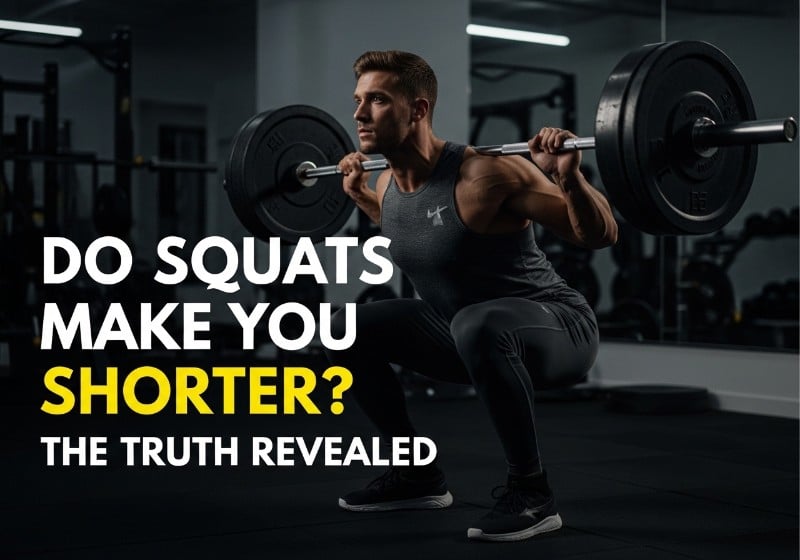
When you place a barbell across your upper back and squat down, your vertebral column absorbs that load. The intervertebral discs — the gel-like cushions sitting between each vertebra — get compressed. That compression is real and measurable.
Studies have actually quantified this. After a session of loaded squats, people tend to be roughly 3–6 millimeters shorter than when they started. It sounds alarming until you realize this is nearly identical to what happens after a long day of standing or walking. Gravity does the same thing to you every single day.
And here’s what most people miss: your height already fluctuates throughout the day naturally. Most adults are about half an inch taller in the morning than they are by evening. That’s not squats — that’s just life. The discs rehydrate and expand overnight while you sleep.
Understanding Spinal Compression During Squats
Why Your Spine Compresses Under Load
The spine is not a rigid rod. It’s a dynamic, load-bearing structure designed to flex, absorb force, and recover. Spinal compression isn’t a sign of damage — it’s the system working as intended.
Walking, running, jumping, even sitting upright all create compressive forces on the lumbar spine. A loaded squat creates more compression than walking, sure, but it’s a difference of degree, not of kind. The spine is built for this.
What tends to happen with progressive strength training is actually the opposite of damage — the discs, vertebrae, and surrounding musculature adapt and become more resilient over time.
Is Spinal Compression Permanent?
Not from normal training. The nucleus pulposus — the fluid core inside each intervertebral disc — draws in water and nutrients during recovery, restoring disc height after loading.
Research on spinal loading consistently shows that temporary height changes from exercise resolve within a few hours, and fully normalize overnight with sleep. A 2018 review in the Journal of Strength and Conditioning Research confirmed that short-term height decrements following resistance training are transient and clinically insignificant in healthy individuals.
Sleep isn’t just recovery for your muscles. It’s when your discs literally rehydrate and decompress.
Can Squats Affect Growth in Teenagers?
This is where the question gets more serious, and more nuanced.
The Role of Growth Plates
Growth plates — also called epiphyseal plates — are areas of cartilage near the ends of long bones where new bone tissue is produced during childhood and adolescence. They’re softer and more vulnerable than mature bone, which is why people worry about resistance training during growth years.
The concern isn’t irrational. A traumatic injury to a growth plate can disrupt bone development. But here’s the key word: traumatic. A poorly programmed, unsupervised lifting session with excessive load is a risk. A well-supervised, age-appropriate strength program is not.
Growth plates in most teenagers close somewhere between ages 14–16 in girls and 16–19 in boys, though this varies. Before closure, they’re worth protecting — not by avoiding all exercise, but by avoiding reckless overloading.
What Research Says About Youth Strength Training
The American Academy of Pediatrics (AAP), the National Strength and Conditioning Association (NSCA), and the American College of Sports Medicine all support youth resistance training when it’s properly supervised and age-appropriate.
A comprehensive review published in Pediatric Exercise Science found that youth resistance training, including lower-body compound movements, was associated with improved bone density, muscle strength, and injury prevention — not growth disruption.
The key safety guidelines for teens come down to a few consistent points: prioritize technique over load, avoid maximal single-rep efforts, ensure adult supervision, and build volume gradually. Following those principles, squats aren’t a threat to a teenager’s development. They’re a benefit.
Do Heavy Squats Stunt Growth?
Where the Myth Came From
This myth has a longer history than most people realize. It likely traces back to early observations of gymnasts and weightlifters who were shorter than average, leading people to assume the sport caused the shorter stature. What the data actually showed, later, was selection bias — shorter athletes were naturally drawn to (and successful in) those sports.
There were also some real injury cases in the 1970s and 1980s involving youth athletes lifting without proper supervision or technique. Those cases got generalized into a broad fear of weightlifting during adolescence, even though the injuries resulted from recklessness, not from squatting itself.
What Modern Research Shows
Contemporary exercise science has largely put this myth to rest. A 2020 position statement from the NSCA confirmed that resistance training does not negatively impact growth or height in youth athletes when performed correctly.
Growth hormone levels actually increase after resistance training, both in youth and adult populations. Strength training, including squats, stimulates bone remodeling and supports skeletal development — it doesn’t impair it.
The risk isn’t the squat. The risk is poor programming, bad form, and loading beyond what a young spine is ready to handle.
How Squats Can Improve Posture and Appearance
Stronger Muscles Support Better Alignment
One of the underappreciated benefits of consistent squatting is what it does to your posture over time. The movement trains the glutes, erector spinae, core, and hip flexors — all of which play a direct role in how you hold yourself upright.
Weak posterior chain muscles tend to produce forward-leaning posture, rounded shoulders, and anterior pelvic tilt. Squatting, done well, progressively strengthens those areas and pulls the body toward neutral alignment.
It’s not a quick fix. But after a few months of consistent training, many people stand noticeably taller — not because their bones grew, but because their muscles finally hold them the way they’re supposed to.
Why Better Posture Can Make You Look Taller
This is one of those things that sounds too simple to be true, but consistently plays out in practice.
Slouching takes height away from you visually. A person standing at 5’10” with rounded shoulders and a forward head might look 5’8″. The same person standing fully upright looks noticeably taller, and that’s without any change to their actual skeletal height.
Athletes who develop strong cores and posterior chains through resistance training often report that people perceive them as taller than before — and in measurable terms, their standing height when fully erect actually increases compared to their habitual slouched posture.
When Squats Can Cause Problems
Poor Form and Excessive Loading
The squat is a technically demanding movement. Done well, it’s one of the safest and most effective exercises available. Done poorly — with excessive forward lean, knee cave, lumbar rounding, or load that exceeds the lifter’s capacity — it places stress on tissues that aren’t prepared for it.
Lower back pain is the most common complaint from beginners who squat with poor form, particularly from excessive lumbar flexion under load. This isn’t a property of the squat; it’s a consequence of technique errors and premature loading.
Common beginner mistakes that create real injury risk:
- Squatting heavier than form allows
- Ignoring mobility limitations (tight hip flexors, limited ankle dorsiflexion)
- Skipping warm-up and general preparation
- No coaching or form feedback early on
Signs of Training Errors
Persistent lower back tightness that doesn’t resolve within 48 hours after a session is worth paying attention to. So is pain that radiates into the glutes or legs, which can indicate nerve involvement. These aren’t “no pain, no gain” situations — they’re signals that something in the movement or programming needs to change.
A physical therapist or qualified strength coach can usually identify the issue quickly. Getting it addressed early is almost always faster and less costly than ignoring it.
Other Exercises That Create Temporary Height Changes
Deadlifts, Running, and Jumping
Squats aren’t unique in this regard. Deadlifts create similar or greater spinal loading. Distance running produces cumulative compression across thousands of foot strikes. Even jumping — which some people think of as “decompressive” — creates significant impact forces on landing.
Here’s a useful comparison:
| Activity | Approximate Spinal Load (relative to body weight) | Temporary Height Change | Recovery Time |
|---|---|---|---|
| Walking | 0.5–1x body weight | Minimal | Hours |
| Running | 2–3x body weight | 2–4 mm | Hours |
| Barbell squat | 3–6x body weight | 3–6 mm | Hours to overnight |
| Deadlift | 4–7x body weight | 4–7 mm | Hours to overnight |
| Sitting for 8+ hours | Sustained low load | 5–8 mm | Overnight |
What’s striking about this table: sitting all day actually produces height loss comparable to heavy lifting — and most people never think twice about it. The compressive effect of sustained static loading is real, which is why movement throughout the day matters more than avoiding exercise.
Recovery Strategies
The discs recover through fluid reabsorption, and that process is enhanced by a few practical habits. Sleep is the most important — 7–9 hours gives the spine time to fully rehydrate. Hydration matters too, since the nucleus pulposus is mostly water.
Mobility work between sessions helps maintain range of motion and keeps surrounding musculature from becoming chronically tight. Rest days aren’t optional for anyone training seriously — they’re where adaptation actually happens.
Benefits of Squats Beyond Strength
Muscle Growth and Athletic Performance
The squat builds quadriceps, hamstrings, glutes, adductors, and calves — the entire lower-body kinetic chain. For athletes in football, basketball, soccer, track, and virtually every other sport popular in the United States, lower-body power is a fundamental performance driver.
Vertical jump, sprint speed, change-of-direction ability — all of these correlate directly with the strength developed through compound lower-body movements like squats. That’s not incidental. The squat trains the movement patterns that underlie explosive athletic output.
Bone Density and Long-Term Health
Resistance training is one of the most effective non-pharmacological interventions for building and maintaining bone density. The mechanical stress of squatting stimulates osteoblast activity — the cells responsible for laying down new bone tissue.
This matters enormously for long-term health. Osteoporosis affects roughly 10 million Americans, and another 44 million have low bone density. Building bone mass during youth and maintaining it through adulthood through resistance training is one of the clearest preventive strategies available.
In other words, squats aren’t just safe for your spine. They’re actively protective of your skeletal health over the long run.
Final Thoughts
The fear that squats shrink you is understandable — it makes intuitive sense that loading a spine would compress it permanently. But the body doesn’t work that way. The spine is adaptive, the discs recover, and the research is clear: properly performed squats pose no risk to permanent height and no meaningful threat to growth in teenagers following sensible programming.
What actually shortens you, visually and functionally, is weak posture and sedentary habits. Squatting consistently tends to push things in the opposite direction.
If you’re new to squatting, prioritize learning the technique before adding load. If you’re a parent wondering whether to let your teenager train, the evidence supports it — with supervision, appropriate loads, and attention to form. And if someone tells you squats will make you shorter, you now have more than enough to explain why that’s not how any of this works.
Fellowship-trained surgical oncologist specializing in minimally invasive procedures and cancer treatment protocols.
Board-certified endocrinologist with 14 years of experience specializing in diabetes management and metabolic disorders.

Frequently Asked Questions
That “shorter after squats” worry usually comes from a real but tiny effect. Loaded squats can squeeze spinal discs a little, so your measured height may dip briefly. After rest or sleep, it typically rebounds.
Teenagers don’t stop growing because they squat with proper coaching. The messy part is reckless loading, sloppy form, or ego-driven max attempts while the body is still developing.
Growth plates can be injured when training gets careless: too much weight, poor supervision, or bad technique. In coached youth programs, age-appropriate resistance training is considered safe [3].
Heavy squats create more spinal compression because your body is carrying extra load. That doesn’t equal damage. It just raises the price of poor bracing, rushed recovery, or messy programming.
Squats can help your posture by building the glutes, hips, core, and upper back. You may look taller simply because you stand better, not because your bones changed.
Deadlifts aren’t worse for height. They just stress the spine differently. Squats load downward through the torso; deadlifts challenge your back position during the pull.
Goblet squats, front squats, and safety bar squats often feel kinder than back squats. Your ankles, hips, torso length, training history, and pain pattern decide more than the exercise name.
Back pain needs medical attention when numbness, weakness, leg pain, bladder or bowel changes, or worsening pain shows up. Sharp, electric symptoms aren’t normal soreness.
References
- Centers for Disease Control and Prevention. Physical Activity Guidelines: Muscle-strengthening activity recommendation for adults.Scholarly Article
- American College of Sports Medicine. Resistance training guidance for health, fitness, and musculoskeletal benefits.Scholarly Article
- National Institutes of Health and related youth resistance training research reviews on pediatric strength training safety.Scholarly Article
- A Biomechanical Review of the Squat Exercise - PMC - NIHScholarly Article
- Live Whole Health #257: You should know Squat! - VA NewsScholarly Article