- 1.Key Takeaways
- 2.Posture Correction Exercises to Look and Stand Taller: Why Posture Changes Your Appearance
- 3.Common Habits That Damage Your Posture
- 4.Best Posture Correction Exercises to Look and Stand Taller
- 5.Stretch Tight Muscles That Pull You Out of Alignment
- 6.Strength Training Exercises That Help You Stand Taller
- 7.Daily Habits That Reinforce Good Posture
- 8.Mistakes That Prevent Better Posture
Most people Googling how to look taller are thinking about bone length. That’s understandable — but it’s also the wrong target. Your skeleton isn’t the variable. Your posture is.
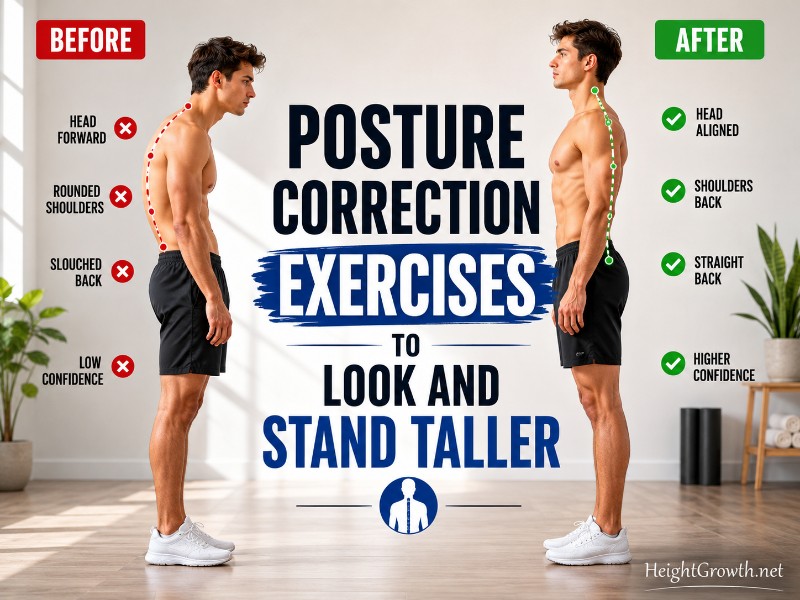
Poor posture can shave off an inch or two of visible height. Rounded shoulders, a forward head, and a collapsed spine don’t just make you look shorter — they compress the space between your vertebrae, strain your muscles, and feed a low-level ache that most Americans have just learned to live with. The desk job didn’t help. The phone definitely didn’t help.
The good news is that posture is trainable. You can’t change how tall you are after your growth plates close, but you can absolutely reclaim the height you’re already losing to slumping.
Posture correction exercises improve your appearance of height by restoring natural spinal alignment, strengthening the muscles that hold you upright, and stretching the tight muscles that pull you forward. Most people can see a visible difference in their standing posture within two to four weeks of consistent practice.
Key Takeaways
- Posture improvement won’t add bone length, but it can visibly restore 1–2 inches of height lost to slouching.
- Forward head posture and rounded shoulders are the two most common drivers of poor posture in American adults.
- A mix of strengthening (rows, planks, glute bridges) and stretching (hip flexors, chest, hamstrings) is more effective than either alone.
- Consistency matters more than intensity — 15 minutes daily beats an hour once a week.
- Workspace and sleep setup either support or undermine every exercise you do.
Posture Correction Exercises to Look and Stand Taller: Why Posture Changes Your Appearance
Your spine has natural curves — cervical, thoracic, and lumbar. When those curves are in their correct relationship to each other, your body stacks efficiently and you stand at your full height.
When they aren’t — when your thoracic spine rounds forward, when your head drifts ahead of your shoulders, when your pelvis tilts — you lose that stack. Your body is carrying load it wasn’t designed to carry at those angles, and the visible result is a shorter, more compressed silhouette.
Fixing alignment doesn’t just look better. It feels better, too.
The Difference Between Standing Taller and Growing Taller
Standing taller and growing taller are completely different things, and conflating them leads to frustration.
Growing taller is a biological process that depends on open growth plates, adequate nutrition, sleep, and genetics — the last of which accounts for roughly 80% of final adult height. (Silventoinen, 2003) Once growth plates fuse, that process is over.
Standing taller is a mechanical problem with a mechanical fix. The intervertebral discs that cushion your vertebrae compress slightly under chronic poor posture and constant gravity. Restoring spinal alignment decompresses them. Your neck muscles, when lengthened out of a permanent forward position, allow your head to sit directly over your shoulders — where it weighs about 10–12 lbs instead of effectively 40–60 lbs as it does when jutted forward at an angle.
The result is a taller, more upright appearance. Not a taller skeleton — a better-used one.
Common Habits That Damage Your Posture
Understanding what’s working against you is half the battle.
Desk Jobs, Smartphones, and Sedentary Living
The average American office worker spends 9–11 hours a day sitting. ([VERIFY: confirm current BLS or CDC sedentary data]) That’s not sitting with perfect posture. That’s sitting in whatever position the chair, desk height, and screen angle happen to push the body into — which, without active effort, is almost always a forward head and rounded upper back.
Smartphone use compounds this. The pattern even has a name: tech neck, sometimes called forward head posture. For every inch your head moves forward from neutral, the effective load on your cervical spine roughly doubles. At 3 inches of forward migration — which is common — your neck muscles are managing the equivalent of 40 lbs instead of 12.
Long commutes, couch time, and general low-movement days reinforce shortened hip flexors and tight chest muscles. Both of those pull the body out of alignment from opposite ends of the spine.
The exercises below address all of it — but they only work if you’re also honest about the hours you spend undoing them.
Best Posture Correction Exercises to Look and Stand Taller
These are the foundational movements. None of them require a gym. Most take under two minutes.
Chin Tucks
Chin tucks directly target forward head posture — the most visible contributor to a shortened appearance.
How to do them: Sit or stand with your spine neutral. Without tilting your head up or down, gently pull your chin straight back, as if creating a double chin. Hold for 3–5 seconds. Release. Do 10–15 reps.
The movement retrains the deep neck flexors to pull the head back over the shoulders, where it belongs. Most people feel the stretch at the base of the skull and the back of the neck on the first rep.
Do these every hour if you’re working at a desk. The effect compounds.
Wall Angels
Wall angels work the muscles that tend to go completely offline in people who sit at computers all day: the rhomboids, lower trapezius, and the muscles that control scapular movement.
How to do them: Stand with your back flat against a wall, feet about 4 inches out. Press your lower back, upper back, and the back of your head against the wall. Raise your arms to a 90-degree “goalpost” position, also against the wall. Slowly slide your arms up overhead, keeping everything in contact with the wall, then slide back down. That’s one rep. Do 10–12.
If you can’t keep your lower back against the wall, that’s valuable information. Tight hip flexors and thoracic immobility are both likely culprits — both addressed in the stretching section below.
Cat-Cow Stretch
Cat-cow is a yoga-derived spinal mobility drill. It’s not glamorous, but spinal flexion-extension mobility is genuinely underrated for people who spend hours in a fixed seated position.
How to do it: Start on all fours, wrists under shoulders, knees under hips. On an inhale, let your belly drop toward the floor, lift your chest and tailbone (cow). On an exhale, round your spine toward the ceiling, tuck your chin and pelvis (cat). Move slowly and deliberately. Do 10 cycles.
The breathing matters — spinal mobility and controlled breathing share neurological territory, and the breath cue makes the movement more effective.
Plank
Posture is a strength problem as much as a flexibility problem. The plank builds the isometric core endurance that lets you actually hold the posture you’re training.
How to do it: Forearms on the floor, elbows under shoulders, body in a straight line from heels to crown. Engage your core and glutes. Hold with a neutral pelvis — no sagging at the hips, no hiking them toward the ceiling. Start with 20–30 seconds and build from there.
The mistake most people make is treating the plank as a core-only exercise. Done correctly, it trains shoulder stability, glute engagement, and full posterior chain tension — all of which matter for standing posture.
Stretch Tight Muscles That Pull You Out of Alignment
Strengthening overstretched muscles is only half the equation. You also need to release the tight ones that are actively pulling your posture out of shape.
Hip Flexor Stretch
Tight hip flexors from prolonged sitting tilt the pelvis forward, which forces the lower back into hyperextension and throws off the entire spinal stack above it.
How to do it: Kneel on one knee (the one on the side being stretched), other foot forward in a lunge position. Gently press your hips forward and slightly tuck your tailbone until you feel a stretch at the front of the hip. Hold 30–45 seconds per side.
Chest Doorway Stretch
Rounded shoulders almost always come with a tight pectoralis major. Releasing the chest is the prerequisite for any upper-back strengthening work to actually hold.
How to do it: Stand in a doorway. Place your forearms on the door frame at a 90-degree angle. Step one foot through the door and lean your chest gently forward until you feel a stretch across the chest and front of the shoulders. Hold 30 seconds. Repeat 2–3 times.
Hamstring Stretch
Tight hamstrings contribute to posterior pelvic tilt, which rounds the lower back and makes it harder to stand in a neutral spinal position.
How to do it: Sit on the edge of a chair. Extend one leg straight in front of you, heel on the floor. Sit tall and gently hinge forward from the hips (not the waist) until you feel a pull behind the knee and thigh. Hold 30–45 seconds per side.
Strength Training Exercises That Help You Stand Taller
The muscles most responsible for good posture — rhomboids, mid-traps, glutes — are chronically weak in people who sit for a living. These four exercises address the full posterior chain.
| Exercise | Primary Target | Equipment Needed | Reps/Sets |
|---|---|---|---|
| Rows | Rhomboids, mid-trap | Resistance band or dumbbells | 3 x 10–12 |
| Face Pulls | Rear deltoids, external rotators | Resistance band (TRX, Theraband) | 3 x 12–15 |
| Glute Bridges | Glutes, hamstrings, lumbar stabilizers | None (bodyweight) | 3 x 15 |
| Dead Bugs | Deep core, hip flexor control | None (bodyweight) | 3 x 8–10/side |
Rows and face pulls directly counter the forward-shoulder position that desk work creates. The goal isn’t to build big muscles — it’s to restore the baseline tension in muscles that have lost the habit of firing.
Glute bridges address the pelvic alignment issue upstream of everything else. Weak glutes let the pelvis tip forward, which cascades up the spine. Three sets of 15 bodyweight bridges, done correctly with a held contraction at the top, is unglamorous but probably one of the highest-value things you can do for standing posture.
Dead bugs train the ability to keep the spine stable while the limbs move — which is, functionally, what posture requires every time you take a step.
Daily Habits That Reinforce Good Posture
Exercises work. Exercises surrounded by 8 hours of undoing them work much less.
Improve Your Workspace
Monitor height matters more than most people think. The top third of your screen should be at eye level — which for most laptop users means getting an external monitor or a stand, because a laptop on a desk forces your head down. Pair that with a chair that supports your lumbar curve (not just props you in a C-shape), and your hip flexors are no longer in a constant shortened position.
Standing desks help, but only if you actually use them. Alternating between sitting and standing every 30–45 minutes is more effective than standing for hours straight.
Sleep Position
Back sleeping with a pillow that supports the natural cervical curve is the most posture-friendly position. Side sleeping is workable if you use a pillow thick enough to keep your head neutral — not tilted toward the mattress. Stomach sleeping keeps the cervical spine in rotation for hours, which tends to feed into the neck tension and forward-head issues you’re trying to fix.
Walking Posture
Walking posture often reveals the underlying problem more clearly than standing. Lead with your chest, not your chin. Shoulders back and down — not forced back in a military brace, just not forward. Eyes level, not fixed on the sidewalk 6 feet ahead.
Driving Posture
Car seats encourage posterior pelvic tilt by design — most Americans drive with their seat back angled too far, which rounds the lower back. Adjust so your seat back is closer to vertical, and use a small lumbar support if needed. Your head should rest against the headrest, not hover forward of it.
Mistakes That Prevent Better Posture
The most common one: overcorrecting. Yanking your shoulders back and arching your lower back into a forced “good posture” position creates new muscle tension and is unsustainable. The goal is neutral — not military.
Inconsistency is the other major issue. Posture is a neuromuscular habit, which means it responds to frequency more than intensity. Fifteen minutes of exercises six days a week will produce faster change than an hour twice a week.
Ignoring flexibility while only doing strength work leaves the tight muscles pulling against your new strength. Both sides of the equation need attention.
Finally — and this is underappreciated — breathing mechanics matter. A collapsed chest restricts the ability to breathe fully, which keeps the thoracic spine in flexion. Practicing deliberate diaphragmatic breathing (belly expands on inhale, not chest) reinforces the thoracic extension you’re training with wall angels and rows.
Fix the breathing. The posture tends to follow.
Pediatrician and public health specialist with expertise in child development, vaccination programs, and community health initiatives.
Research dietitian and nutrition scientist focused on evidence-based dietary interventions for chronic metabolic conditions.

Frequently Asked Questions
Yes — consistently practicing upright alignment can make you appear 1 to 2 inches taller without any change in actual height. When the thoracic spine is rounded, height is literally compressed out of the spine. Restoring natural curves brings that height back.
For most people, 4 to 5 sessions per week produces the best results. Lower-effort exercises like chin tucks and shoulder blade squeezes can be done daily or multiple times throughout the day.
Frequently, yes. Forward head posture places sustained strain on the suboccipital muscles at the base of the skull — a common source of tension-type headaches. Chin tucks and upper cervical stretching directly address this.
No. The musculoskeletal system responds to new loading patterns at any age. Adults well into their 50s and 60s see meaningful posture improvement with consistent exercise and habit adjustment
Most foundational exercises — wall drills, chin tucks, planks, hip flexor stretches — require no equipment at all. A resistance band adds useful variety and is inexpensive to find at most U.S. retailers.
Adjusting monitor height to eye level and doing chin tucks every hour tend to produce the fastest day-to-day relief. Ergonomic screen positioning reduces the forward head load that drives most desk-related neck and upper back tension.
If posture-related pain is severe, persistent, accompanied by numbness or tingling in the arms or legs, or not improving after several weeks of consistent exercise, it's worth consulting a healthcare provider to rule out disc or nerve involvement.