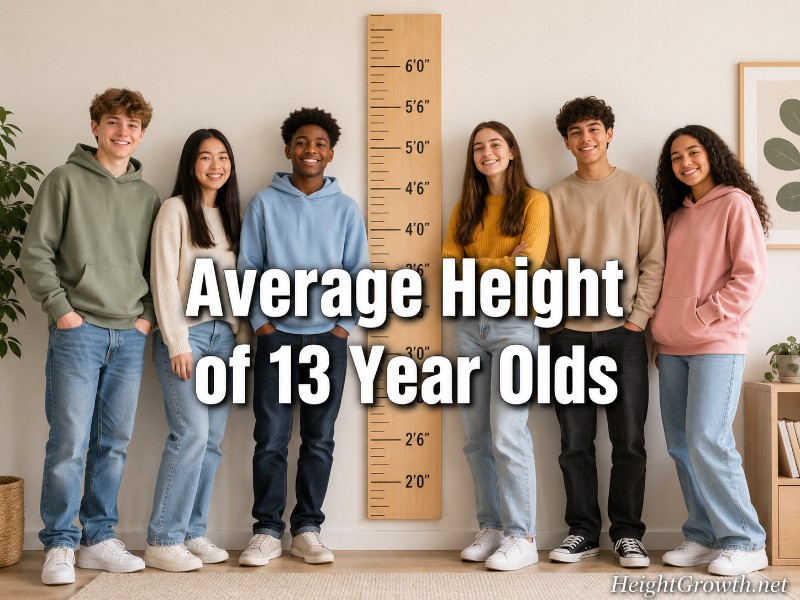
If you've ever caught yourself wondering whether your 13-year-old is growing "on track," you're not alone. It's one of the most common questions pediatricians hear at annual checkups — and honestly, it makes complete sense. Thirteen is right in the thick of puberty, which means growth can look wildly different from one kid to the next, even among classmates who share the same birthday.
The short answer is that there's a pretty wide range of what's considered normal at this age. The CDC and the American Academy of Pediatrics (AAP) both emphasize that healthy growth isn't about hitting a specific number — it's about your child following a consistent growth curve over time. One measurement tells you very little. A pattern of measurements tells you a lot.
This article walks through the average height for 13-year-olds, what influences those numbers, how to read a growth chart without losing your mind, and when it actually makes sense to bring up concerns with a pediatrician.
Key Takeaways
- The average height for a 13-year-old boy is roughly 61.5 inches (5'1.5"); for a girl, about 62 inches (5'2").
- Normal height at 13 spans nearly 10 inches across the 5th to 95th percentile — a wide range is expected.
- Genetics is the strongest single predictor of how tall a child will grow.
- Pediatricians watch for consistency along a growth curve, not a fixed number.
- Growth spurts happen earlier in girls (ages 11–13) and later in boys (ages 13–15).
Average Height of 13 Year Old Boys and Girls in the United States
The first thing worth knowing is that boys and girls at 13 tend to be at very different stages of puberty — and that gap in timing shows up directly in their heights. According to CDC Growth Charts, the numbers are close but the stories behind them are quite different.
Normal range: 56.5 – 66 in
Normal range: 57.5 – 66.5 in
Average Height for 13-Year-Old Boys
The average height for a 13-year-old boy sits at roughly 61.5 inches, or about 5 feet 1.5 inches (approximately 156 centimeters). That's the 50th percentile on CDC growth charts — meaning half of boys this age are taller and half are shorter.
The normal range is actually quite broad. A boy at the 5th percentile sits around 56.5 inches (about 4 feet 8.5 inches), while a boy at the 95th percentile reaches roughly 66 inches (5 feet 6 inches). That's a spread of nearly 10 inches — all within normal adolescent development.
Most 13-year-old boys are still in earlier stages of puberty. The big growth spurt for boys tends to peak closer to age 13 or 14, so many boys at this age are just beginning to accelerate. Some won't hit their peak growth velocity until they're 14 or even 15.
Average Height for 13-Year-Old Girls
Girls at 13 are typically taller than boys their age — at least temporarily. Because girls enter puberty roughly 1.5 to 2 years earlier than boys, many 13-year-old girls have already been through significant growth.
The average height for a 13-year-old girl is about 62 inches, or 5 feet 2 inches (around 157.5 centimeters). Girls at the 5th percentile measure roughly 57.5 inches, while those at the 95th percentile are closer to 66.5 inches.
For many girls, growth starts slowing after age 13 or 14. The peak growth spurt in girls usually happens between ages 11 and 13, so a significant portion of their adult height is already in place by 13. This is part of why girls briefly "overtake" boys during the early teen years.
What Is Considered a Healthy Height at Age 13?
Here's something that trips a lot of parents up: there's no single "ideal" height at 13. What a pediatrician is actually looking for isn't a specific measurement — it's whether a child is growing consistently along their own curve.
A child who has always been at the 15th percentile and stays there is growing just fine. A child who drops from the 70th percentile to the 30th in a short period of time warrants a closer look, even if the absolute height seems unremarkable.
The CDC growth charts — which your child's doctor uses at every annual checkup — track height over time for exactly this reason. The goal is longitudinal consistency, not a magic number. BMI and body proportions also factor in, but height percentile trends are among the most useful data points for monitoring healthy growth.
Factors That Affect the Average Height of a 13 Year Old
Growth at 13 isn't random. Several interconnected factors shape how tall a child is and how fast they're growing — and some are well within a family's control.
The strongest single predictor of height. Doctors sometimes calculate "mid-parental height" — a rough estimate based on both biological parents' heights — to gauge genetic potential.
Protein, calcium, and vitamin D directly support bone development. The USDA recommends teens get 1,300 mg of calcium daily. Prolonged deficits can genuinely slow growth.
Growth hormone is released primarily during deep sleep. The Sleep Foundation recommends 8–10 hours per night for teens. Chronic sleep deprivation can blunt hormone production over time.
Regular activity supports healthy bone density and muscle development. Exercise doesn't "make" kids taller, but it supports the conditions for growth to happen at its natural pace.
Genetics
Genetics is the biggest single determinant of height. Kids of tall parents tend to be taller; kids of shorter parents tend to be shorter. It's not a perfect formula, but the influence of inherited traits is strong. For boys, doctors add 5 inches to the mother's height, then average it with the father's height. For girls, they subtract 5 inches from the father's height and average it with the mother's. It's not destiny, but it gives a useful ballpark for genetic potential.
Nutrition
Good nutrition directly supports bone development and growth velocity. Protein helps build tissue; calcium and vitamin D are essential for bone density; zinc and iron matter more than most people realize. The USDA's dietary guidelines recommend that teens get adequate protein, 1,300 mg of calcium daily, and enough vitamin D to support calcium absorption. Severely restricted diets — including prolonged caloric deficits or elimination of entire food groups without medical guidance — can genuinely slow growth in adolescents.
Sleep and Physical Activity
Growth hormone is released primarily during deep sleep. This isn't a minor detail — it's one of the main reasons the Sleep Foundation recommends that teenagers get 8 to 10 hours of sleep per night. Regular physical activity supports healthy bone density, muscle development, and overall growth. Youth sports, daily movement, outdoor play — none of these "make" a child taller, but they support the conditions for growth to happen at its natural pace.
Understanding Growth Spurts During Puberty
Puberty reshapes everything — including how fast kids grow. Growth spurts during adolescence are driven by hormones, particularly estrogen in girls and testosterone in boys, both of which trigger skeletal growth from the growth plates at the ends of bones.
Girls typically experience their peak growth velocity between ages 11 and 13, often growing 2 to 3 inches per year during the peak. Boys peak a little later, usually between 13 and 15, and can gain 3 to 4 inches in a single year during the most active phase.
At 13 specifically, you might be watching a girl who's already past peak velocity and slowing down — or a boy who's just entering it and about to shoot up. Both situations are entirely normal. The endocrine system runs on its own timeline, and that timeline varies considerably between individuals.
Average Height Percentile Chart for 13-Year-Olds
Percentiles can feel abstract until you understand what they actually represent. A child at the 50th percentile isn't "average" in a value judgment sense — it just means 50% of kids that age are taller and 50% are shorter. Being at the 10th or 90th percentile is not inherently good or bad.
| Percentile | Boys — height | Boys — cm | Girls — height | Girls — cm |
|---|---|---|---|---|
| 5th | 56.5 in (4'8.5") | 143.5 cm | 57.5 in (4'9.5") | 146 cm |
| 25th | 59.5 in (4'11.5") | 151 cm | 60.5 in (5'0.5") | 153.5 cm |
| 50th ★ | 61.5 in (5'1.5") | 156 cm | 62 in (5'2") | 157.5 cm |
| 75th | 63.5 in (5'3.5") | 161.5 cm | 63.5 in (5'3.5") | 161 cm |
| 95th | 66 in (5'6") | 167.5 cm | 66.5 in (5'6.5") | 169 cm |
| Based on CDC 2000 Growth Charts for the United States. ★ = median (50th percentile) | ||||
Notice how close boys and girls are at the 50th percentile at age 13 — girls are only slightly taller on average. But the stories behind those similar numbers differ: most girls at the upper percentiles have largely completed their growth spurts, while boys at those same percentiles are often still mid-spurt and have significant growth ahead of them. That gap in timing is what leads to boys eventually surpassing girls in height by their mid-teens.
When Should Parents Be Concerned About Height?
Most height differences at 13 are completely normal and driven by natural variation in puberty timing. But there are specific patterns that warrant a conversation with a pediatrician.
Signs worth mentioning at a checkup
- A child who has dropped two or more major percentile channels (e.g., from 70th to 30th) over 12 to 18 months
- No signs of puberty in a boy by age 14 or a girl by age 13
- Height significantly below the 3rd percentile with no obvious family history to explain it
- Slowed growth that coincides with other symptoms like fatigue, unexpected weight gain, or delayed development
In some cases, a pediatric endocrinologist may evaluate for conditions like growth hormone deficiency, thyroid dysfunction, or other endocrine disorders. These cases aren't common, but they're worth ruling out when growth patterns look genuinely unusual.
Delayed puberty doesn't always mean a problem — "constitutional growth delay" is a recognized pattern where kids simply start puberty later but end up at a normal adult height. A pediatrician can help distinguish that from something that needs further evaluation.
Frequently Asked Questions About the Average Height of 13 Year Olds
Can a 13-year-old still grow taller?
Almost certainly, yes. Most 13-year-olds — especially boys — still have several years of growth ahead of them. Girls may have less growth remaining, but many still add 1 to 2 inches after 13. Growth plates typically close between 16 and 18 for girls and 18 and 21 for boys.
Is being shorter than average normal?
Absolutely. The 5th percentile means roughly 5 out of every 100 kids are at or below that height — and most of them are perfectly healthy. Short stature only becomes a clinical concern when it falls below the 3rd percentile, drops across percentile channels, or occurs alongside other developmental concerns.
Does puberty affect final adult height?
Yes, significantly. Puberty is when the majority of adult height increase happens. The timing also matters — kids who enter puberty earlier tend to finish growing earlier, while late bloomers often catch up and end up at a similar adult height to peers who developed earlier.
How much do 13-year-olds usually grow each year?
During active puberty, boys typically grow 3 to 4 inches per year at peak velocity, while girls usually grow 2 to 3 inches per year. Outside of peak growth periods, annual growth of roughly 1.5 to 2.5 inches is common for adolescents.
Can nutrition or exercise increase height?
Good nutrition and adequate sleep support a child in reaching their genetic height potential — but they don't add height beyond what genetics allows. If a child has been malnourished, improving nutrition can help restore growth. Otherwise, no supplement or exercise routine meaningfully increases height in a child who's already adequately nourished and active.
Height at 13 is genuinely one of those things that looks more alarming than it usually is. The range of normal is wide, puberty timing explains most variation, and the CDC growth charts exist precisely to help parents and pediatricians zoom out and look at the trend rather than panicking over a single number.
If your child's growth has been consistent over time, they're eating and sleeping reasonably well, and puberty is progressing without obvious delays — that's a good picture. Bring any lingering concerns to your child's pediatrician at their annual checkup. That's exactly what those visits are for.
This article is for informational purposes only and does not constitute medical advice. Always consult a qualified healthcare provider for concerns about your child's growth and development.
Pediatrician and public health specialist with expertise in child development, vaccination programs, and community health initiatives.
Fellowship-trained surgical oncologist specializing in minimally invasive procedures and cancer treatment protocols.