- 1.What Is the Average Height in Germany?
- 2.How Germany Compares to the United States
- 3.Historical Height Trends in Germany
- 4.Factors That Influence Average Height in Germany
- 5.Average Height by Age Group in Germany
- 6.Germany's Position Among the Tallest Countries in Europe
- 7.How Height Affects Everyday Life in Germany
- 8.Common Myths About German Height
- 9.Frequently Asked Questions About Average Height in Germany
- 10.Key Takeaways on Average Height in Germany
If you’ve ever wondered how Germans stack up — literally — against Americans and other Europeans, you’re not alone. Height statistics turn out to be more useful than most people expect. They show up in healthcare planning, military fitness standards, sports recruitment, and even how clothing brands design their size charts. Germany consistently ranks among Europe’s taller nations, and the numbers behind that reputation are worth knowing.
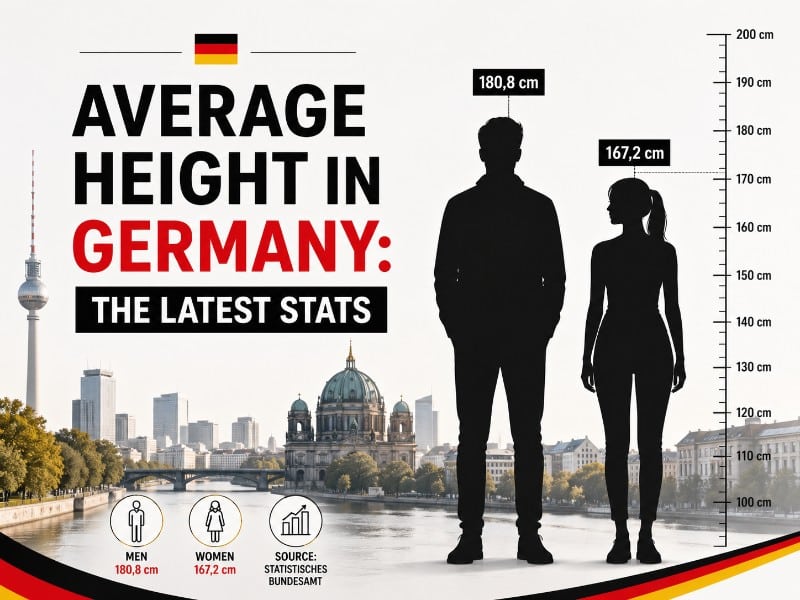
The average height for German men sits at roughly 5 feet 11 inches (180.3 cm). German women average around 5 feet 5.5 inches (166.4 cm). Those figures come from national health surveys and anthropometric studies conducted across adult populations in Germany. They’re not dramatic outliers in the global picture, but they do place Germany firmly above the world average — and comfortably ahead of the United States.
What Is the Average Height in Germany?
Average Height of German Men
German men average approximately 180 cm, or about 5’11”. That figure reflects data from adult males aged 18 and older, drawn from national health interview and examination surveys.
Historically, German men were considerably shorter. In the early 1900s, the average hovered closer to 167–168 cm. The dramatic climb through the 20th century reflects massive improvements in food security, public health infrastructure, and overall living standards. By the mid-20th century, height gains were accelerating quickly — and by the 1980s, the curve had started to level off.
Today’s younger German men are only marginally taller than men born in the 1970s and 80s. The big leaps already happened. What’s left is incremental.
Average Height of German Women
German women average around 166 cm, or roughly 5’5.5″. Like their male counterparts, younger women tend to be slightly taller than older generations, though the gap narrows significantly once you get to women born after 1970.
Age matters here in another way too. Natural height loss begins in the 40s and 50s as spinal discs compress and bone density gradually declines. So the “average German woman” figure shifts slightly depending on which age cohort you’re measuring. Health surveys that skew older will show slightly lower averages than those focused on adults under 40.
How Germany Compares to the United States
Average Height Germany vs USA
Here’s a straightforward look at how the two countries compare:
| Population Group | Germany | United States | Difference |
|---|---|---|---|
| Adult Men | 180.3 cm / 5’11” | 175.3 cm / 5’9″ | ~5 cm / ~2 inches taller |
| Adult Women | 166.4 cm / 5’5.5″ | 161.5 cm / 5’3.5″ | ~5 cm / ~2 inches taller |
Personal note on this table: the roughly 2-inch gap is consistent across both sexes, which suggests it’s not a fluke of one dataset. The CDC’s National Center for Health Statistics puts American adults at meaningfully shorter than their German counterparts — and that gap has been holding steady for years.
Germany simply has a longer track record of high-quality nutrition and universal healthcare access, particularly through the critical childhood development years. That foundation shows up in the numbers.
Why Small Differences Matter
Two inches doesn’t sound like much until you think about what it means at scale. Consumer product manufacturers design furniture, vehicles, and workstations based on population averages. A country that’s consistently 5 cm taller than its trading partner needs different ergonomic defaults — different seat heights, different reach distances, different clothing cuts.
In athletics, that 2-inch difference changes roster dynamics for basketball, volleyball, and rowing teams. In healthcare, population height and body composition data feed into disease risk models, BMI thresholds, and growth monitoring charts. Even military fitness standards are calibrated against national averages.
The differences are small. Their downstream effects aren’t.
Historical Height Trends in Germany
Height Growth During the 20th Century
The story of German height is really a story of recovery and prosperity. In the late 19th and early 20th centuries, average heights were suppressed by poor nutrition, infectious disease, and inadequate healthcare — the same story you’d find across most of Europe at the time.
The post-World War II economic recovery, known as the Wirtschaftswunder or “economic miracle,” brought rapid improvements in protein availability, food variety, and healthcare access. Children born in the 1950s and 60s grew up taller than their parents by meaningful margins. Childhood nutrition, particularly adequate protein and micronutrient intake, proved to be the single most powerful lever.
Modern Height Trends
That rapid growth has slowed considerably. Germany, like most wealthy Western nations, appears to have approached a biological plateau. The environmental factors that limited height in earlier generations — malnutrition, disease burden, poor prenatal care — have largely been addressed. What’s left is mostly determined by genetics.
Research from NCD Risk Factor Collaboration data suggests Germany’s mean adult height hasn’t changed dramatically since roughly the 1980s. Some studies indicate a marginal increase in younger cohorts, but nothing like the gains seen across the 20th century. The era of dramatic secular height increases in Germany is, for practical purposes, over.
Factors That Influence Average Height in Germany
Genetics and Heredity
Genetics account for roughly 60–80% of an individual’s final height, according to most estimates in human genetics research. Population-level height differences between countries reflect the cumulative genetic heritage of those populations — including centuries of migration patterns, ancestry mixing, and selection pressures.
Germany’s population draws from a range of Central and Northern European ancestries, many of which are associated with taller-than-average stature. That genetic baseline gives German height statistics a natural head start compared with populations whose ancestry skews toward shorter-average regions.
Nutrition and Diet
For the remaining 20–40% that environment controls, nutrition is the dominant factor. Protein intake during childhood and adolescence — particularly during growth spurts — has an outsized effect on final height. Calcium and vitamin D for bone development, zinc for cellular growth, and adequate overall caloric intake all feed into the process.
Germany’s diet historically centered on meat, dairy, bread, and legumes — a relatively protein-dense pattern that supported healthy development. Modern German diets have diversified considerably, but the nutritional baseline remains solid.
Healthcare and Living Conditions
Prenatal care quality, access to vaccinations, management of childhood illness — these aren’t usually what people think of when they think about height, but they matter. Illness during critical growth periods can permanently impair a child’s height potential. Germany’s universal healthcare system and strong public health infrastructure have consistently minimized those interruptions across the population.
Average Height by Age Group in Germany
Young Adults
Germans aged 18–30 tend to cluster around the national averages or slightly above them — roughly 181 cm for men and 167 cm for women. They grew up in an era of nutritional abundance and comprehensive pediatric healthcare, so their heights reflect near-optimal development conditions.
Older Adults
Germans over 60 show lower average heights, reflecting both the natural aging process and the less favorable development conditions of their childhood decades. Many were born in the 1940s and 50s, when postwar food scarcity was still a factor.
Height Changes With Aging
Adults typically begin losing height in their 40s, gradually at first, then more noticeably after 60. Spinal disc compression, reduced bone density, and postural changes all contribute. Women tend to lose height faster than men after menopause, largely due to accelerated bone density reduction. By their 70s, many adults are 2–4 cm shorter than their peak young-adult height.
Germany’s Position Among the Tallest Countries in Europe
Countries With Taller Average Heights
Germany doesn’t top the European charts. The Netherlands holds a well-documented lead, with Dutch men averaging around 182.5 cm — consistently ranking among the tallest male populations globally. Montenegro and Bosnia and Herzegovina also post impressive male averages, often cited in the 182–183 cm range in broader European datasets.
Countries With Similar Heights
Denmark, Sweden, and Austria cluster close to Germany’s figures, all landing in the 179–181 cm range for men. These countries share similar ancestral patterns, nutritional histories, and healthcare infrastructure, which probably explains the convergence.
Germany sits in the upper tier of European height rankings — not at the very top, but well above the continental average.
How Height Affects Everyday Life in Germany
Clothing and Fashion Sizing
European sizing systems are built around European body measurements, and German brands like Adidas and Puma calibrate their cuts accordingly. If you’re shopping German or broader European clothing and coming from an American background, you’ll notice that inseam lengths, shoulder widths, and torso proportions tend to run slightly longer — reflecting the taller population these brands are designed for.
Sports and Athletics
In Bundesliga soccer, player height profiles skew toward the taller end compared with some other major leagues. Basketball and volleyball programs in Germany actively recruit players who fit the anthropometric profile suited for elite competition. Height isn’t the only variable in athletic scouting — but it’s rarely irrelevant.
Workplace and Ergonomic Design
German engineering and industrial design standards incorporate population anthropometrics into their ergonomic guidelines. Vehicle interiors, workstation setups, and public infrastructure like seating and handrail heights are all calibrated to a population that averages nearly 180 cm for men. That attention to ergonomics shows up in design quality that translates well to similarly tall populations, and less seamlessly to shorter ones.
Common Myths About German Height
Are All Germans Tall?
No, and the average doesn’t tell that story. Regional variation across Germany is real — northern regions tend to skew slightly taller than southern Bavaria, for example. Individual variation within any population is enormous. Plenty of German men are under 170 cm; plenty are over 190 cm. The average is a useful summary, not a description of any individual.
Is Height Determined Only by Genetics?
Genetics sets the ceiling; environment determines how close you get to it. Two people with identical genetic potential for height can end up meaningfully different in stature if one had severely limited nutrition or chronic illness during childhood. Genes matter enormously, but they don’t operate in a vacuum.
Does Height Continue Increasing Forever?
Growth plates — the cartilaginous regions at the ends of long bones — close in late adolescence, typically by the late teens for women and early 20s for men. After that, further height gain isn’t biologically possible. What you see is what you get, barring unusual medical conditions.
Frequently Asked Questions About Average Height in Germany
What is the average height of a German man?
The average German man stands approximately 180 cm (5 feet 11 inches). This figure comes from national health examination data covering adult males 18 and older.
What is the average height of a German woman?
German women average around 166 cm (5 feet 5.5 inches). Younger women tend to cluster slightly above this average, while older women often measure slightly below it due to age-related height reduction.
Is Germany one of the tallest countries in Europe?
Germany ranks in the upper tier of European height — above average, but not at the very top. The Netherlands, Montenegro, and Bosnia and Herzegovina generally post higher male averages. Germany’s figures are roughly comparable to Denmark, Sweden, and Austria.
How does German height compare with Americans?
German men average roughly 5 cm (about 2 inches) taller than American men. German women show a similar gap over American women. The CDC places average American male height at approximately 175.3 cm, compared to Germany’s roughly 180.3 cm.
Why are Germans relatively tall?
A combination of favorable genetics, historically protein-rich nutrition, universal healthcare access, and high living standards through critical childhood development periods has supported taller average heights in Germany. These factors have compounded across generations.
Key Takeaways on Average Height in Germany
Germany’s height statistics tell a straightforward story once you look at the full picture.
- German men average around 180 cm (5’11”); German women average around 166 cm (5’5.5″).
- Germany sits in the upper tier of European height rankings, trailing only the Netherlands and a few Balkan countries at the top.
- German adults are roughly 2 inches taller on average than their American counterparts, a gap that has held consistently across datasets.
- The dramatic height gains of the 20th century have plateaued — Germany’s population height has largely stabilized since the 1980s.
- Genetics, childhood nutrition, and healthcare access are the three most reliable predictors of a population’s average height.
Height data isn’t just trivia. It feeds into everything from ergonomic design to sports science to cross-border apparel sizing. Understanding where Germany fits in that picture helps explain a lot about how German products, healthcare systems, and athletic programs are built — and how they interact with populations that look a little different on the measurement chart
Pediatrician and public health specialist with expertise in child development, vaccination programs, and community health initiatives.
Board-certified endocrinologist with 14 years of experience specializing in diabetes management and metabolic disorders.

Frequently Asked Questions
Height statistics shift because studies use different age groups, years, countries, and methods. Measured height is usually stronger data than self-reported height, since people tend to round up. A centimeter here, two there—suddenly the national average looks different.
German men average roughly 179–180 cm. Younger men tend to land closer to the higher end, while older groups often measure a little shorter because childhood conditions were different decades ago—and, yes, people do lose some height with age.
German women average around 165–166 cm. That’s taller than the global female average and usually above women in countries such as France or Japan, though still a bit below the Netherlands and Sweden.
Germans are taller than Americans on average. German men sit near 180 cm, compared with about 176–177 cm for American men. German women average about 166 cm, while American women are closer to 163 cm [2].
Germans are not taller than Dutch people on average. The Dutch still occupy that “why is everyone eye-level with the doorframe?” category, with men often estimated around 183 cm and women around 170 cm [2].
Germany’s height profile comes from a stack of advantages, not one magic cause. Genetics matter, but childhood nutrition, healthcare, sanitation, and stable living conditions also shape growth. Height is more like compound interest than a switch—small gains build across childhood.
Average height in Germany has mostly leveled off. The big jump happened during the 20th century, when food quality, medicine, and living standards improved fast. Recent generations show slower change because the population is already close to its likely biological ceiling.
Nutrition won’t make adult bones longer once growth plates have closed. Good food still supports posture, muscle, bone density, and general health, but it doesn’t stretch the legs or spine after puberty. Annoying, but that’s how the body works.
East and West Germany have shown some height gaps across generations. Those differences mostly trace back to post-war living conditions, childhood nutrition, and historical development. Since reunification, the gap has become much smaller.
References
- Robert Koch Institute, DEGS and GEDA health monitoring data.Web Page
- World Health Organization, child growth and health statistics resources.Scholarly Article
- https://ec.europa.eu/eurostat/web/microdata/european-health-interview-surveyWeb Page
- NCD Risk Factor Collaboration, global adult height trends.Scholarly Article
- German Federal Statistical Office, population and health-related demographic data.Scholarly Article
- Hatton, T. J., “How have Europeans grown so tall?”, Oxford Economic PapersScholarly Article
- CDC/NCHS, United States adult body measurement data.Scholarly Article