- 1.Key Takeaways
- 2.Does Ballet Actually Make You Taller?
- 3.How Height Is Determined
- 4.Why Ballet Dancers Often Look Taller
- 5.Can Ballet Help Children Grow Taller?
- 6.The Stretching Myth, Specifically
- 7.Common Myths About Ballet and Height
- 8.Benefits of Ballet Beyond Height
- 9.Tips for Improving Your Posture With Ballet-Inspired Exercises
- 10.Frequently Asked Questions About Ballet and Height
- 11.Final Takeaway: Does Ballet Make You Taller?
Ballet dancers carry themselves differently. The long neck, the open shoulders, the way they seem to take up vertical space even at 5’4″ — it’s convincing enough that plenty of parents enroll their kids specifically hoping the height benefit is real.
It probably isn’t. Not the way most people imagine, anyway.
Here’s what ballet actually does to your height — and why the visual effect is so easy to mistake for the real thing.
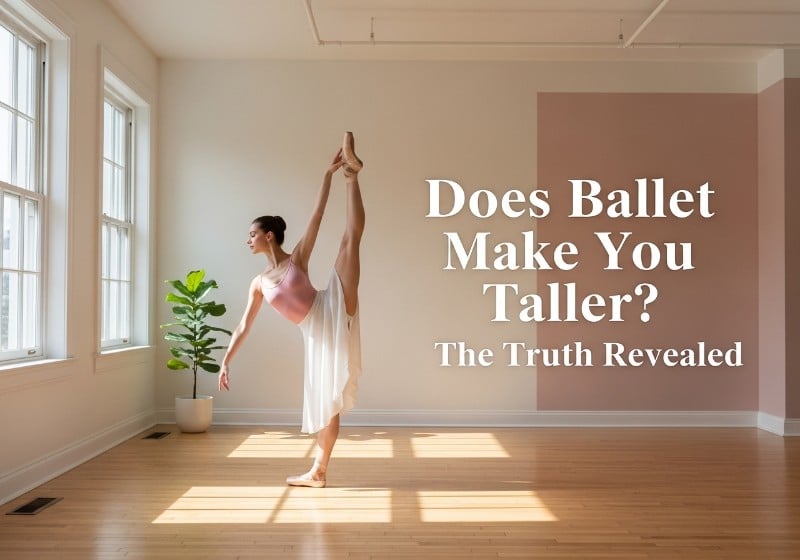
Does ballet make you taller? Ballet does not increase bone length or permanently add inches to your height. Once your growth plates close — typically by the late teens — no exercise can lengthen your skeleton. What ballet genuinely does is improve posture and body alignment, which can make you appear noticeably taller without changing your actual height at all.
Key Takeaways
- Ballet cannot lengthen bones or override your genetic height ceiling.
- Genetics account for roughly 80% of your final adult height, with nutrition, sleep, and activity filling the rest. (Silventoinen, 2003)
- Ballet’s “taller effect” is real — it comes from improved posture, not skeletal growth.
- For children still growing, ballet supports healthy development without harming growth plates when practiced appropriately.
- The genuine benefits of ballet — flexibility, strength, coordination, body awareness — are worth having regardless of any height effect.
Does Ballet Actually Make You Taller?
The direct answer: no, ballet does not increase your height in any measurable skeletal sense.
Bone length is fixed by your epiphyseal plates — the growth plates at the ends of your long bones. While those plates are still open during childhood and adolescence, the right conditions (good nutrition, adequate sleep, physical activity) allow your bones to grow toward their genetic potential. Once the plates close, usually between ages 14–16 for girls and 16–18 for boys, longitudinal bone growth stops. No amount of stretching, dancing, or any other exercise reopens them.
What ballet can do — and does quite well — is decompress the spine temporarily and train the postural muscles that determine how upright you stand. Someone who practices ballet consistently tends to stand taller than their actual height suggests, because they’ve trained away the slump most people carry around all day.
That’s not nothing. But it’s a different thing than growing.
How Height Is Determined
Most of your height was decided before you were born.
Genetics account for up to 80% of final adult height in developed countries, according to a widely cited review in the Journal of Biosocial Science. (Silventoinen, 2003) The remaining 20% is shaped by environmental factors — nutrition being the most important, followed by sleep, illness history, and physical activity.
Nutrition matters most during the childhood and adolescent growth windows. Protein and height growth are closely linked — protein provides the amino acids needed for bone and tissue development. Calcium and vitamins for height growth, especially vitamin D, support skeletal mineralization. (Perkins et al., 2016)
Sleep matters too, and it’s more specific than “get enough rest.” Growth hormone is primarily released during deep slow-wave sleep, not gradually throughout the day — it comes in pulses, mostly in the first few hours after falling asleep. (Shaw et al., 2023) For a growing teenager, consistently cutting sleep short is one of the more effective ways to leave height on the table.
Exercise — ballet included — plays a supporting role. It promotes bone density and healthy skeletal development, but it doesn’t add centimeters the way nutrition and sleep do.
Why Ballet Dancers Often Look Taller
Here’s the part that actually explains the persistent myth.
Ballet training is systematic postural conditioning. Dancers spend years learning to elongate the spine, retract the shoulders, extend the neck, and engage the core — not as a warmup cue, but as a baseline standing position. The result is a body that occupies vertical space more efficiently than average.
Think about what poor posture actually does. Rounded shoulders, a forward head position, and a compressed lumbar spine can easily cost someone an inch or more of apparent height. Ballet systematically addresses all of those patterns.
The visual effect goes further. Ballet training lengthens and strengthens the muscles along the posterior chain and around the hips, which improves pelvic alignment. Neutral pelvis means the spine sits straighter above it. Add long, lean limbs trained for extension — the pointed foot, the lifted arm — and even a 5’3″ dancer reads as tall in a way that has nothing to do with bone length.
So when someone says “ballet made her look taller,” they’re not wrong. They’re just describing something that happened to posture, not skeleton.
Can Ballet Help Children Grow Taller?
For kids who are still growing, the question shifts slightly — and the answer is more interesting.
Ballet doesn’t directly stimulate bone growth. But physical activity during childhood and adolescence does support healthy skeletal development. Weight-bearing activities, in particular, are associated with better bone mineral content and density in adolescents. (Exercise bone meta, Front Pediatr., 2025) Ballet is moderately weight-bearing — less so than running or jumping sports, but still counts.
The more relevant point: ballet practiced at appropriate intensity doesn’t harm growth plates in children. The concern with youth exercise and growth plates is mostly relevant to high-impact, repetitive loading — certain strength training protocols, for example. Ballet at the recreational and early training levels doesn’t fall into that category.
What ballet can do for a growing child is help them develop the postural habits early that make the most of whatever height they eventually reach. A teenager who has spent years learning to stand correctly will carry themselves better through adulthood than one who never had that training.
That’s a real, lasting benefit — even if it shows up in appearance rather than a tape measure.
The Stretching Myth, Specifically
One claim deserves its own section because it comes up so often: the idea that the deep stretching in ballet permanently lengthens the spine and adds height.
Here’s what stretching actually does to the spine. The intervertebral discs between your vertebrae are compressible — they’re compressed throughout the day just from standing and sitting upright under gravity. Lying down, hanging, or doing yoga-style spinal stretches can temporarily decompress those discs and give you a few millimeters back. You can measure this effect with a stadiometer in the morning versus the evening.
The key word is temporary. The discs recompress. The height returns to baseline. Does stretching make you taller in any permanent sense? No — there’s no mechanism by which stretching soft tissue lengthens bone or permanently changes disc height.
What stretching can do is improve range of motion and reduce the postural compression that comes from tight hip flexors, hamstrings, and thoracic muscles. That, again, can translate to a more upright posture and a taller appearance — but it’s not height growth.
Common Myths About Ballet and Height
| Myth | Reality |
|---|---|
| Ballet lengthens bones | No exercise lengthens bones after growth plates close |
| Professional dancers are tall because of ballet | Selection bias — many companies have minimum height requirements, so tall dancers are selected, not created |
| Stretching permanently adds height | Spinal decompression from stretching is temporary, not structural |
| Adults can grow taller through dance | Adult skeletal growth is not possible once epiphyseal plates have fused |
| Ballet gives everyone a lean, tall body type | Ballet changes posture and muscle tone; it does not alter skeletal proportions |
The professional dancer height point is worth dwelling on. It’s easy to look at a corps de ballet, notice that everyone is tall and lean, and conclude ballet caused it. In reality, most major companies have explicit height ranges — typically 5’2″–5’8″ for women, taller for men — and audition thousands of dancers to find bodies that fit. The causality runs the other direction.
Benefits of Ballet Beyond Height
If you’re dismissing ballet because it won’t add inches, reconsider.
The actual benefits of consistent ballet training are well-documented and genuinely valuable. Flexibility improves significantly — not just hamstring length, but hip mobility, thoracic rotation, and ankle range of motion that most adults lose by their 30s. Balance and proprioception (your body’s sense of where it is in space) improve in ways that have measurable effects on injury prevention and athletic performance.
Core strength is another one. Ballet core training isn’t the same as crunches — it’s deep stabilizer work, the kind that keeps the spine aligned under load and reduces lower back pain. And does ballet make you taller in terms of cardiovascular fitness? Moderately — a full ballet class runs 60–90 minutes of continuous moderate-intensity movement.
The posture improvements are probably the most transferable benefit for non-dancers. Standing taller, moving with more coordination, carrying yourself with more body awareness — those things affect how you’re perceived and how you feel, even if they don’t change what the tape measure reads.
Tips for Improving Your Posture With Ballet-Inspired Exercises
You don’t need pointe shoes to get the postural benefits. A few targeted exercises, done consistently, reproduce most of what ballet does for alignment.
Chin tuck with wall support. Stand with your back against a wall, heels 2 inches out, and gently press the back of your skull toward the wall while keeping your chin level. Hold 10 seconds. This counteracts the forward head position that most screen-heavy adults develop.
Pelvic neutral standing. Ballet spends enormous time on pelvic alignment. Stand with feet hip-width apart and consciously release the anterior pelvic tilt — the tendency to let the lower back arch and the belly push forward. Stack your hips under your ribcage. This alone adds visible height for many people.
Shoulder blade retraction and depression. Draw your shoulder blades down and together — not aggressively, just out of the hunched-forward position. Hold while you breathe. Practice it while sitting at your desk. It becomes automatic faster than you’d expect.
Single-leg balance work. Stand on one foot for 30–60 seconds, focusing on a fixed point. This trains the stabilizer muscles in the ankle, knee, and hip that support upright posture when you’re moving, not just standing still.
These aren’t glamorous. They’re also genuinely effective — the kind of thing a physical therapist would prescribe, dressed in ballet vocabulary.
Frequently Asked Questions About Ballet and Height
Can adults get taller from ballet?
No. Once your growth plates have closed — which happens by the late teens for most people — your skeleton cannot grow longer. Ballet can improve posture and make you appear taller, and spinal decompression from stretching offers a temporary (hours, not permanent) effect, but it cannot change your skeletal height.
Do professional ballet dancers have a height advantage because of training?
Mostly not. Most major companies select dancers within specific height ranges at audition. The height you see in professional ballet reflects casting preferences and selection, not a training effect. Ballet training can improve how fully a dancer expresses their height through posture, but it doesn’t create height that wasn’t there genetically.
Is ballet better than yoga for posture?
They target similar things through different methods. Ballet emphasizes alignment through dynamic movement — you’re maintaining posture while moving, which builds stability differently than static yoga holds. Yoga tends to offer more targeted flexibility work and is more accessible for beginners. For posture specifically, both are effective; the better one is whichever you’ll actually do consistently.
How long does it take to see posture improvements from ballet?
Most people notice a difference within 6–8 weeks of consistent practice (two or more sessions per week). The early gains come quickly because you’re mostly learning to turn off the compensatory tension patterns — rounded shoulders, forward head — that developed over years of sitting. Sustaining and deepening those improvements takes longer.
Can barre workouts provide similar benefits?
Yes, for the posture and strength components. Barre fitness borrows the alignment principles and muscle-conditioning elements from ballet without the technical demands of classical technique. It’s a reasonable substitute if the goal is postural improvement and lower-body strength rather than dance training specifically.
Final Takeaway: Does Ballet Make You Taller?
Ballet will not add a single measurable inch to your skeletal height. That’s not a criticism of ballet — it’s just not a thing exercise does to bone once the growth windows have closed.
What ballet does reliably is improve posture, alignment, and the way you carry your existing height. For many people, that difference is visible enough to be mistaken for actual height gain. If someone who has practiced ballet for two years looks taller to you, they probably are — in every practical sense except the tape measure.
For children still in their growth years, the case for ballet is even easier: it supports the kinds of physical development that allow kids to reach their genetic height potential, while building flexibility, strength, and body awareness that pay off for decades.
The height it gives you isn’t the kind you measure. It’s the kind you project
Fellowship-trained surgical oncologist specializing in minimally invasive procedures and cancer treatment protocols.
Board-certified endocrinologist with 14 years of experience specializing in diabetes management and metabolic disorders.

Frequently Asked Questions
A lot of people notice dancers seem longer and assume actual height changed. But after puberty, once your growth plates have closed, ballet does not make your bones grow. What it can change—sometimes quite noticeably—is your posture, alignment, and the way your body carries itself. So you may look taller, even though your height stays the same.
This gets misunderstood all the time. Ballet does not directly add height in the teen years, but it can support healthy development while your body is still growing. In practice, your height still comes from biology: genetics, hormones, and growth plates that remain open. Ballet is more of a supporting factor, not the driver.
Stretching can give you that lengthened feeling right away. You may even stand a bit taller for a while because of less spinal compression and better mobility. Still, it does not permanently lengthen bones, which is the part people usually hope for.
A dancer’s line does a lot of visual work. Strong posture, lifted core support, open shoulders, a long neck, and lean muscle shape can all make you appear taller than you actually are.
Ballet itself does not stunt growth. The real concern tends to be poor nutrition, too much training, or repeated injuries during key growing years.
Not really. No sport consistently pushes you past your natural height range. Ballet changes posture more than height, while other sports create different visual effects. Growth biology, though, stays pretty much the same.
References
- Ann Hum Biol . 2006 May-Jun;33(3):342-56. doi: 10.1080/03014460600635951. The influence of dance training on growth and maturation of young females: a mixed longitudinal studyScholarly Article
- Int J Eat Disord. Author manuscript; available in PMC: 2024 Sep 1. Published in final edited form as: Int J Eat Disord. 2023 Jun 1;56(9):1743–1751. doi: 10.1002/eat.24005 Body dissatisfaction, ideals, and identity in the development of disordered eating among adolescent ballet dancersScholarly Article
- Sports Med . 1995 Dec;20(6):375-97. doi: 10.2165/00007256-199520060-00004. The effects of exercise on growthScholarly Article
- J Bone Miner Res. 2007 Dec 10;23(7):986–993. doi: 10.1359/JBMR.071201 Impact Exercise Increases BMC During Growth: An 8-Year Longitudinal StudyScholarly Article
- FDA Approves First Drug to Improve Growth in Children with Most Common Form of DwarfismScholarly Article
- Physical Activity Guidelines for AmericansWeb Page