- 1.Key Takeaways
- 2.1. Two Different Bone Properties, Constantly Confused
- 3.2. What Bone Length Actually Refers To
- 4.3. What Bone Density Actually Refers To
- 5.4. How Bones Actually Get Longer
- 6.5. So What Actually Determines Adult Height?
- 7.6. Can Denser Bones Make You Taller?
- 8.7. Medical Conditions That Change the Picture
- 9.8. Supporting Bones Through Different Life Stages
- 10.9. Myths Worth Retiring
- 11.Final Thoughts
You’ve probably heard some version of “build stronger bones, grow taller” — usually from a supplement ad, occasionally from a well-meaning relative. It’s an easy mix-up. Both ideas involve bones, and “stronger” sounds suspiciously close to “bigger.” It isn’t.
Here’s the split, plainly: bone length decides how tall you stand. Bone density decides how sturdy your bones are. The two barely talk to each other.
Key Takeaways
- Bone length, not bone density, is what sets your height.
- Bones lengthen during childhood and the teen years through structures called growth plates.
- Genetics accounts for roughly 60–80% of adult height (Silventoinen, 2003; Yengo et al., 2022).
- Nutrition, sleep, and hormone balance help you get to your genetic ceiling — they don’t raise it.
- Once growth plates close, usually by the late teens, adult height is more or less locked in.
1. Two Different Bone Properties, Constantly Confused
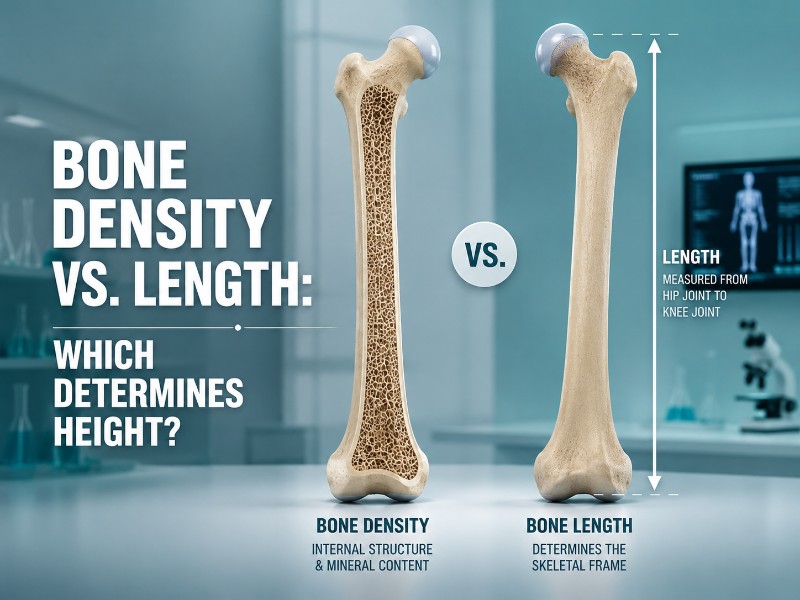
Bone length is a measurement — how far one end of a bone sits from the other. Long femurs and a long spine add up to a tall person. Simple enough.
Bone density is something else entirely: how tightly packed the mineral content (mostly calcium and phosphorus) is inside the bone tissue. Denser bone resists fractures better. It doesn’t stretch further.
Picture two rods, same length, one steel, one aluminum. Same length, wildly different density. Neither rod gets longer because it’s denser. Your femur works on the same logic.
2. What Bone Length Actually Refers To
This is the linear measurement of your long bones — the ones running through your limbs and spine:
- Femur — the thigh bone, longest one you’ve got
- Tibia and fibula — lower leg
- Humerus — upper arm
- Vertebral column — a stack of individual vertebrae
Add these up and you basically get your standing height. Long femur, long legs. Tall vertebrae, long torso. It’s not much more complicated than that mechanically.
Bone length only increases during the growth years — childhood through adolescence — courtesy of specialized cartilage sitting at the ends of each bone.
3. What Bone Density Actually Refers To
Density gets measured with a DEXA scan, which reports bone mineral content per square centimeter. Doctors use it to flag fracture risk, not height.
More mineral packed in means bones tend to be:
- Stronger and less prone to breaking
- Better at handling compression
- More capable of supporting body weight over the decades
Two cell types keep this balanced. Osteoblasts lay down new mineralized tissue. Osteoclasts clear out old or damaged bone. When that cycle stays even, density holds steady — it peaks in your late 20s to early 30s, then slides downward with age, which is part of why osteoporosis shows up later in life.
4. How Bones Actually Get Longer
The growth happens at the epiphyseal growth plate (also called the physis) — thin bands of cartilage near each end of a long bone.
During childhood and puberty, cartilage cells there divide and push the bone ends apart. The older cartilage hardens into bone behind them. Repeat that cycle enough times and the bone gets measurably longer.
A few hormones run this show:
- Growth hormone (GH), from the pituitary gland, keeps the growth plate active
- IGF-1, released by the liver in response to GH, does the direct work of promoting cartilage and bone growth
- Estrogen and testosterone, both surging during puberty, speed growth up at first — then trigger the plates to close
Puberty growth spurts trace back to this hormonal sequence. Boys tend to hit their big spurt somewhere between 11 and 16; girls, usually 9 to 14.
When the Plates Close
By the end of puberty, rising estrogen (in both sexes) hardens the cartilage completely. Growth plates close around ages 16–17 in girls and 18–19 in boys, give or take — there’s real individual variation here.
After that, height is set. No amount of stretching, supplementing, or hanging from a bar changes it.
5. So What Actually Determines Adult Height?
Height is polygenic — hundreds of genes each nudging the outcome slightly. Twin studies keep landing on the same range: genetics explains 60–80% of adult height variation in populations with decent nutrition (Silventoinen, 2003).
Parental height remains the single strongest predictor. Pediatricians sometimes use mid-parental height as a rough estimate:
- Boys: (father’s height + mother’s height + 5 inches) ÷ 2
- Girls: (father’s height + mother’s height − 5 inches) ÷ 2
The leftover 20–40% comes down to environment:
- Nutrition — protein intake, calcium, and vitamin D matter during the growth years (Perkins et al., 2016)
- Sleep — most growth hormone gets released during deep sleep, which is part of why consistent sleep matters so much for kids
- Physical activity — weight-bearing movement supports healthy bone development
- Chronic illness — extended illness or malnutrition in childhood can shave off final height
None of this overrides genetics. It just determines whether a kid actually reaches the ceiling their genes set — or comes up short of it.
6. Can Denser Bones Make You Taller?
No. Density is about mineral concentration, not length, and one doesn’t shift the other.
Denser bones weigh more and hold up better structurally, but their outer dimensions stay put. Whatever calcium concentration your femur happens to carry has zero bearing on how many inches it measures.
This myth persists because “strong” and “big” feel like they should be related. They aren’t. Some notably tall people have below-average bone density. Some short people have unusually dense bones. The two traits just don’t move together.
| Property | Affects | Doesn’t Affect |
|---|---|---|
| Bone length | Height, limb span | Bone strength |
| Bone density | Fracture resistance, bone mass | Height, bone length |
7. Medical Conditions That Change the Picture
Some conditions push growth off its normal track, in either direction.
Conditions Linked to Shorter Stature
- Growth hormone deficiency — insufficient GH means the growth plates get under-stimulated, slowing growth and, without treatment, reducing adult height
- Vitamin D deficiency — severe or long-term deficiency impairs calcium absorption; in kids, this can lead to rickets, which softens and deforms bone
- Hypothyroidism — low thyroid hormone slows growth plate activity
- Scoliosis — a sideways spinal curve shortens the effective vertical length of the spine, reducing standing height
- Osteoporosis — in older adults, vertebral compression fractures can cause measurable height loss over time, sometimes 1–3 inches across a lifetime
Conditions Linked to Taller Stature
- Gigantism — excess GH before the growth plates close drives unusually tall stature; Robert Wadlow, the tallest documented person at 8’11”, had a pituitary tumor causing this
- Marfan syndrome — a connective tissue disorder often producing tall stature, long limbs, and a narrow frame
Dwarfism
Achondroplasia, the most common form, comes from a mutation in a gene regulating bone growth. It mostly shortens the long bones of the limbs while trunk height stays closer to typical.
8. Supporting Bones Through Different Life Stages
Childhood and Adolescence
The goal here isn’t forcing extra height — it’s helping a kid reach whatever their genetics allow while building bone that holds up long-term.
Nutrition priorities that come up again and again in the research: adequate calcium, vitamins tied to growth (vitamin D especially, since it drives calcium absorption), and enough protein for bone matrix formation — most kids get this last one covered through a normal varied diet.
On the lifestyle side: weight-bearing activity (running, jumping, sports that load the skeleton) stimulates bone-building. Consistent sleep matters more during growth spurts, when GH secretion peaks overnight. And sugary drinks have been associated with lower bone density in teens — worth knowing, even if no one wants to hear it.
Adulthood
Once peak bone mass is reached, usually in the late 20s, the goal shifts from building to preserving.
Continued weight-bearing and resistance exercise signals the body to hang onto bone density rather than let it slide. Skipping cigarettes and going easy on alcohol helps too, since both speed up bone loss. And bone density screening — generally recommended for women over 65 and men over 70, earlier if risk factors exist — catches problems before a fracture does it for you.
9. Myths Worth Retiring
“Stretching makes you taller as an adult.” Not really. It can improve posture and flexibility, which might make you look a touch taller by undoing spinal rounding — often less than half an inch, and that’s posture, not bone.
“Certain supplements increase adult height.” No supplement changes height once the growth plates are closed. Products marketed toward adult height gain — collagen blends, amino acid stacks, herbal extracts — don’t have credible clinical backing.
“Heavier, denser bones make you shorter.” Bone density has minimal effect on posture or standing height in healthy people. Gravity doesn’t treat dense bone any differently.
“Spinal decompression can make you taller.” Inversion tables and decompression therapy do temporarily reduce spinal compression, adding a small, short-lived amount of height — gone within hours once normal activity compresses the spine again.
“Good posture permanently increases height.” Better posture helps you stand at your actual full height instead of a slouched, shorter-looking version of it. It doesn’t touch bone structure.
Final Thoughts
Bone density and bone length do separate jobs, and confusing them leads to some pretty persistent myths about what actually changes your height.
If you’re an adult asking whether there’s still a way up, the plain answer is that height settles once the growth plates close. From there, the relevant question shifts to bone strength — density work protects against fractures and matters for mobility later in life, even though it won’t add an inch.
If you’re a parent thinking about a child’s growth, the levers that actually move are food, sleep, activity, and catching any nutritional gaps early. Where that lands a given kid, height-wise, still comes down mostly to genetics none of us get to pick.
Cardiologist and researcher with over a decade of clinical experience in heart disease prevention and cardiovascular risk reduction.
Fellowship-trained surgical oncologist specializing in minimally invasive procedures and cancer treatment protocols.

Frequently Asked Questions
Not really. Dense bones become stronger and more durable, but they don’t stretch or grow longer. Your overall height stays tied to bone length.
Once your growth plates close — usually after the teen years — your height is basically set. Better density helps protect your skeleton, though, especially during aging.
Genetics drives most of it. Bone length matters more than density ever does. Hormones, nutrition, sleep, and childhood health shape growth too, and sometimes unevenly.
During childhood, movement supports healthy growth. In adulthood, exercise changes posture and strengthens bones, which can make you look taller for a while.
Usually because spinal discs compress and posture shifts over time. Leg bones rarely “shrink.”
Absolutely. Strong bones lower fracture risk and help you stay mobile longer.
References
- Is height determined by genetics?Scholarly Article
- J Pediatr. Author manuscript; available in PMC: 2017 Jun 1. Published in final edited form as: J Pediatr. 2016 Mar 26;173:32–38. doi: 10.1016/j.jpeds.2016.02.068 The Biology of StatureScholarly Article
- Bone density testWeb Page
- Bone Density Scan - medlineplusScholarly Article
- Bone Density Testing Information for ProfessionalsScholarly Article
- Indian J Endocrinol Metab. 2020 Jun 30;24(3):275–279. doi: 10.4103/ijem.IJEM_101_20 Does Bone Mineral Apparent Density Facilitate Accurate Identification of Osteoporosis in the Short Postmenopausal Women?Scholarly Article