- 1.Key Takeaways
- 2.1. Dress for Vertical Lines
- 3.2. Choose the Right Shoes
- 4.3. Master Petite Shopping in the US
- 5.4. Hairstyles That Add Height
- 6.5. Improve Posture for Instant Height
- 7.6. Accessories That Elongate
- 8.7. Fitness and Strength for Body Confidence
- 9.8. Mindset: Confidence Is the Real Height Booster
- 10.9. Seasonal Style Adjustments for US Climates
- 11.Final Thoughts
Here’s a number worth knowing: according to the Centers for Disease Control and Prevention (CDC), the average height for adult women in the United States is around 5 feet 4 inches. That means roughly half the women in this country are shorter than that benchmark — and yet, the fashion industry, media, and even shoe aisle layouts still seem designed for someone a full head taller.
The Short Girl Guide isn’t about apologizing for your height or outsmarting genetics. It’s about using what you know — proportion, posture, color, fit — to look and feel exactly as tall as you want to. Most of the tips here cost nothing. A few require a modest investment, maybe $50 to $150 in updated basics. All of them are practical, tested, and grounded in real-world American retail.
Confidence, it turns out, adds more perceived height than any heel ever could. But a good heel doesn’t hurt either.
Key Takeaways
- The average US woman stands 5’4″ — petite height is statistically normal, not the exception.
- Monochrome outfits, high-waisted bottoms, and vertical lines create instant visual length.
- Pointed-toe shoes, nude heels, and platform sneakers elongate the leg line without sacrificing comfort.
- Posture alone can add 1 to 2 visible inches — no shopping required.
- Confidence psychology research consistently shows that self-presentation beats physical height in perceived authority.
1. Dress for Vertical Lines
Clothing structure does a lot of the visual work for you. The goal is something designers call vertical elongation — using seams, colors, and silhouette to draw the eye up and down rather than side to side.
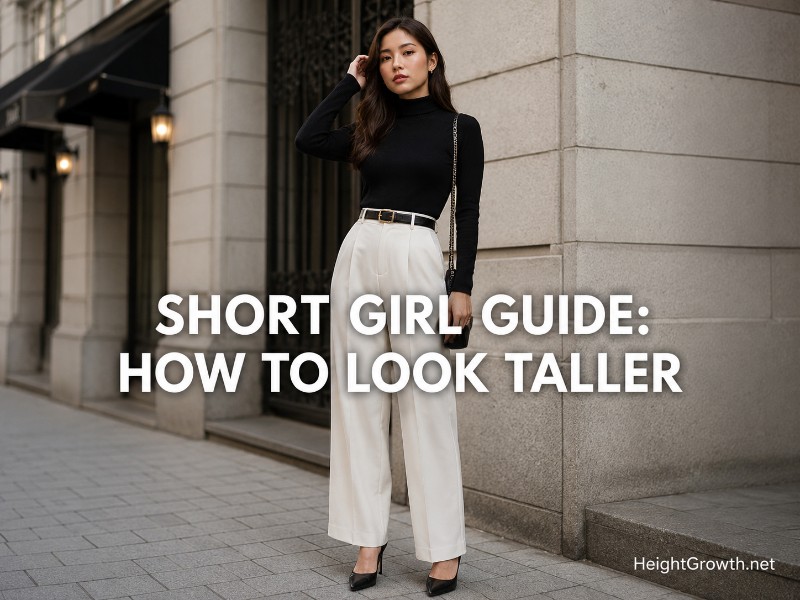
Monochrome outfits are probably the most underrated trick in the petite styling playbook. Wearing the same color family from top to bottom — say, all navy or all camel — removes the visual “break” at the waist and hip, and the body reads as one continuous line. It doesn’t have to be exact matchy-matchy. Similar tones work just fine.
High-waisted bottoms shift the perceived waistline upward, which makes the leg appear longer. Pair them with a slightly cropped or tucked top and the proportion shift is immediate. This is why high-waisted jeans became such a dominant silhouette in American casual wear — they genuinely work for most body types.
Vertical stripes help, but they’re not magic. A thin, spaced stripe is more effective than a bold one. Horizontal stripes, on the other hand, work against you by widening the visual field. Cropped jackets are also worth keeping in the rotation — they sit above the hip, protecting the high-waist illusion rather than covering it.
Tailoring is worth mentioning here. Even budget-friendly clothes from stores like H&M or Target can look elevated after a $15 to $25 hem alteration. Off-the-rack petite sizing exists for a reason, but even petite lines aren’t cut for every body.
2. Choose the Right Shoes
Footwear has an outsized effect on perceived leg length, and a few specific choices make a visible difference.
Nude heels that closely match your skin tone create the illusion of a continuous, unbroken leg line. The shoe essentially disappears, and what’s left is the impression of longer legs. This isn’t new advice, but it still holds up. Brands like Sam Edelman and Steve Madden both offer a solid range of nude pumps in the $60 to $100 range.
Pointed-toe shoes — whether heeled or flat — extend the visual line of the foot forward, adding apparent length. A rounded or square toe cuts the line short. It’s a small detail, but side-by-side the difference is noticeable.
Platform sneakers have become a practical everyday option, especially for women who spend most of the day on their feet. Nike and several other American brands now offer platform versions of classic styles that add 1 to 1.5 inches without any of the discomfort of a traditional heel. For a comfortable working heel height, roughly 2 to 3 inches tends to be the sweet spot — enough to make a difference, not so much that it changes how you walk.
One thing to avoid: ankle straps. They cut across the narrowest part of the leg and visually shorten it. Unless the strap is very thin and sits high, it tends to work against the elongation effect.
| Shoe Type | Effect on Leg Line | Comfort Level | Approx. Cost (USD) |
|---|---|---|---|
| Nude pointed heels | Excellent elongation | Moderate | $60–$120 |
| Platform sneakers | Good lift, casual | High | $80–$130 |
| Ankle strap flats | Shortens leg line | High | $40–$90 |
| Block heels | Moderate elongation | High | $50–$110 |
| Rounded toe flats | Neutral/slightly shortening | High | $30–$80 |
Personal note on this table: the ankle strap column surprises people, but once you notice it, you can’t unsee it. Try both styles in a mirror and the difference is immediately obvious.
3. Master Petite Shopping in the US
“Petite” in American retail sizing doesn’t mean small — it means proportionally shorter. Petite garments are typically cut for women 5’4″ and under, with shorter inseams, sleeve lengths, and torso measurements. Understanding this distinction is where a lot of petite shoppers save time and money.
Nordstrom, Banana Republic, and Loft all carry dedicated petite lines with meaningful selection. Loft in particular tends to be budget-friendly, with petite pants regularly in the $60 to $80 range. Nordstrom’s in-house brands offer slightly higher price points but excellent fit consistency.
Online shopping opens up the selection considerably. Most major retailers now include a petite filter. When searching for jeans, check for inseam measurements — petite inseams typically run 28 to 30 inches, versus the standard 32 inches.
One budget-conscious strategy: buy standard sizing on sale and budget $20 to $40 for simple alterations. A tailor can hem pants, shorten sleeves, and take in waists — often faster and cheaper than people expect.
4. Hairstyles That Add Height
Hair is a legitimate styling tool, and for petite women, the direction is mostly up.
High ponytails and top knots add a literal few inches while drawing attention to the upper portion of the face and neck. They also have the effect of elongating the neck, which contributes to overall perceived height.
Crown volume matters more than people realize. Flat, sleek styles — especially long hair worn straight and heavy — tend to compress the visual height of the upper body. A little root lift, whether from a volumizing spray or a diffuser on the blow dryer, changes the silhouette noticeably.
Strategic layers help too. Face-framing layers create movement and can direct attention upward, while blunt cuts with no layering can sometimes weigh the style down visually. Very long hair, worn past the shoulder blades, can drag the eye downward — which isn’t necessarily a problem, but it’s worth knowing.
5. Improve Posture for Instant Height
This one is free and works immediately. Poor posture — shoulders rolled forward, chin tucked down, spine curved — can subtract a visible inch or two from your actual height. Correcting it adds that back.
Shoulder alignment is the quickest fix. Drawing shoulders back and down opens the chest and instantly changes how a person carries themselves. It also affects how clothes hang — a well-fitted shirt looks better on a straight spine than a hunched one.
Core engagement supports posture over time. Pilates and yoga are both worth exploring for this reason. They build the deep abdominal and back muscles that make good posture feel natural rather than effortful. For office workers, ergonomic desk setup matters too — monitor height, chair position, and lumbar support all affect how the spine holds itself over an 8-hour workday.
Walking with intent — head level, gaze forward, comfortable stride — communicates confidence in a way that people perceive before they consciously register it. That’s not a small thing.
6. Accessories That Elongate
Scale and proportion apply to accessories too.
Long pendant necklaces create a vertical line down the center of the chest — exactly the elongating effect that monochrome outfits create, but in a single accessory. A layered long chain adds visual interest while reinforcing the vertical direction.
For bags, structured crossbody bags work better than oversized totes. A bag that’s too large can visually overwhelm a petite frame and make the person wearing it appear smaller by comparison. A sleek, medium-sized structured bag keeps proportions balanced.
High-rise belts — worn at the natural waist or just above — emphasize the vertical break where the waist is narrowest and reinforce the high-waisted silhouette. A thin belt works better than a wide one for this purpose.
One thing to skip: oversized prints. Large-scale patterns have the same widening effect as horizontal stripes. Smaller, tighter prints or solid colors keep the proportions clean.
7. Fitness and Strength for Body Confidence
Strength training changes posture in ways that directly affect how tall someone looks. Building core and glute strength supports spinal alignment, which is the foundation everything else builds on.
You don’t need a gym membership for this. A set of adjustable dumbbells in the $60 to $100 range covers most foundational movements — squats, deadlifts, rows, presses. Resistance bands, which cost under $30, add variety for glute and core work specifically.
The body neutrality movement has made meaningful ground in American fitness culture, and it’s a useful frame here. The goal isn’t to look different. It’s to feel capable, grounded, and at home in your body — which, incidentally, changes how others perceive you too.
8. Mindset: Confidence Is the Real Height Booster
Social perception research consistently finds that confidence, posture, and vocal presence matter more than physical height in how others assess someone’s authority and competence. This isn’t motivational fluff — it’s documented across multiple fields of study.
Reframing “short” as “petite” is a small linguistic shift that carries real psychological weight. The word petite is neutral, even elegant. It describes proportion without implying limitation.
American celebrities like Ariana Grande (5’0″) and Lady Gaga (5’1″) built massive cultural presence that has nothing to do with their height. What they have in common is deliberate self-presentation — style, posture, and the kind of presence that fills a room. That’s learnable.
Power pose theory, popularized by Amy Cuddy’s research, suggests that body language affects not just how others perceive you but how you feel internally. Standing tall, taking up space, and moving with intention are habits that compound over time.
9. Seasonal Style Adjustments for US Climates
Petite styling requires a few seasonal adjustments to stay proportional year-round.
Fall is tricky because layering adds bulk. The solution is slim layering — a fitted turtleneck under a structured blazer rather than a bulky sweater over a loose shirt. Keeping the layers close to the body preserves the silhouette.
Winter coats are where proportions go wrong most often. A midi-length coat on a petite frame can swamp the lower half of the body. Knee-length or just-below-knee coats tend to hit better. Belted styles help restore the waistline definition that heavy outerwear erases.
Summer is the easiest season for petite dressing. Monochrome dresses, high-waisted shorts, and simple sandals work effortlessly. The challenge is shoes — summer sandals with multiple straps can cut the leg line. A simple slide or minimalist sandal reads cleaner.
For holiday styling — Thanksgiving dinners, Christmas parties, Fourth of July gatherings — the same principles apply. A fitted midi dress with a V-neck elongates. An empire waist shifts the eye upward. A wrap silhouette creates the illusion of a longer torso.
Final Thoughts
The real takeaway from this Short Girl Guide isn’t any single tip — it’s the underlying logic. Visual height is mostly about uninterrupted vertical lines, proportion-aware choices, and the confidence to own the space you’re in. Some of these adjustments cost nothing. A few cost the price of a tailor’s session or a pair of pointed flats.
What tends to happen when women apply even two or three of these consistently is that the question of height becomes less interesting. Not because height stops mattering to anyone around them, but because it stops being the thing they’re managing. That’s the actual goal.
Pediatrician and public health specialist with expertise in child development, vaccination programs, and community health initiatives.
Cardiologist and researcher with over a decade of clinical experience in heart disease prevention and cardiovascular risk reduction.

Frequently Asked Questions
According to the CDC, the average height for adult women in the United States is approximately 5 feet 4 inches. Women shorter than this are statistically in the majority — petite height is common, not unusual.
Monochrome outfits, high-waisted bottoms, vertical stripes, and cropped or tailored jackets all create the visual illusion of added height. The goal is an uninterrupted vertical line from shoulder to toe.
Nude heels that match skin tone, pointed-toe flats, and platform sneakers all elongate the leg line. Ankle straps cut the line and tend to shorten the visual leg length.
Loft, Banana Republic, and Nordstrom all carry dedicated petite lines. Most major online retailers now include petite filters. Inseam measurements in the 28–30 inch range typically indicate petite proportions.
Yes, noticeably. Rolled shoulders and a curved spine can subtract 1 to 2 inches of apparent height. Drawing the shoulders back, engaging the core, and walking with the chin level can restore that and change how clothes fit and hang.
High ponytails, top knots, and styles with crown volume draw the eye upward and add apparent height. Heavy, flat styles worn long down the back tend to drag the eye downward.
Long pendant necklaces create a vertical line that elongates the torso. Small-to-medium structured bags keep proportions balanced. Oversized bags or bold horizontal patterns can visually shrink the wearer by comparison.
Strength training — particularly core and glute work — improves posture over time, which directly affects apparent height and overall body confidence. Home setups with dumbbells under $100 are sufficient for most foundational movements.