- 1.How Teenagers Grow Taller During Puberty
- 2.Why Protein Is Essential for Teen Growth
- 3.Can Eating More Protein Make Teenagers Taller?
- 4.Best Sources of Protein for Teenagers
- 5.How Much Protein Do Teenagers Need Each Day?
- 6.Other Nutrients That Support Height Growth
- 7.Lifestyle Habits That Influence Height Growth
- 8.Common Mistakes Parents and Teens Make
- 9.Final Thoughts
Every parent has stood behind their teenager at a doorframe, marveling at how fast they shoot upward. And somewhere in that mix of pride and panic, the question shows up: is your teen eating enough protein? Does it actually matter for how tall they’ll grow?
The honest answer is more nuanced than most nutrition articles let on. Protein matters — genuinely, significantly — but it’s one piece of a larger biological puzzle. Understanding how it all fits together helps you make smarter decisions without falling for the myths that float around endlessly on social media and parenting forums.
How Teenagers Grow Taller During Puberty
Height isn’t random. It’s the result of a highly coordinated biological process driven by genetics, hormones, and the structural behavior of something called growth plates — thin layers of cartilage located near the ends of long bones like the femur and tibia.
During puberty, the pituitary gland ramps up production of Human Growth Hormone (HGH). That hormone signals the epiphyseal plates (the scientific name for growth plates) to generate new cartilage cells, which then harden into bone through a process called ossification. This is bone elongation in its most literal form.
In girls, this peak height velocity — the fastest period of vertical growth — typically happens between ages 10 and 14. Boys tend to hit theirs a bit later, roughly between 12 and 16. Testosterone and estrogen play different roles here. Estrogen, somewhat counterintuitively, is what eventually causes growth plates to close in both sexes. Once those plates fuse, height is essentially locked in.
Genetics sets the ceiling. But nutrition, sleep, and lifestyle determine how close you get to it.
Why Protein Is Essential for Teen Growth
Think of protein as the construction crew, not the blueprint. The genetic blueprint already exists. Protein is what actually builds the structure.
During adolescence, the body is running an aggressive construction project around the clock — building muscle tissue, repairing cells, producing structural proteins like collagen, and assembling the bone matrix that gives skeletal structure its density and strength. All of that requires amino acids, which are the individual building blocks that protein breaks down into during digestion.
Some of those amino acids are essential, meaning the body can’t manufacture them on its own and has to get them from food. Without a steady supply, protein synthesis slows down. Osteoblasts — the cells responsible for building new bone — need adequate protein to do their job. Collagen, which makes up roughly 30% of bone by mass, is itself a protein.
Nitrogen balance is another useful concept here. When teens are growing, the body needs to be in positive nitrogen balance — taking in more nitrogen (from protein) than it excretes. Negative nitrogen balance, common during illness or undereating, actually causes the body to break down muscle and slow development.
This is why adequate daily protein intake isn’t optional during adolescence. It’s foundational.
Can Eating More Protein Make Teenagers Taller?
Here’s where things get honest. Protein supports the growth process, but it doesn’t override genetics. Eating extra chicken breast won’t push a teen past their genetically determined height ceiling.
Research from the National Institutes of Health (NIH) and other bodies consistently shows that nutritional adequacy protects growth potential — it doesn’t expand it beyond what genetics permits. The more accurate framing: protein deficiency can stunt growth, while adequate protein helps teens reach the height they were genetically meant to hit.
Malnutrition during adolescence has well-documented effects on linear growth. Studies from regions with chronic protein deficiency show measurable reductions in final adult height compared to populations with adequate nutritional status. That’s a meaningful finding — it confirms protein’s role isn’t trivial. But it also underscores the directional logic: deficiency causes harm, while sufficiency enables normal development.
A teen who already eats enough protein won’t grow taller by doubling their intake. What they will do is support muscle recovery, maintain hormonal balance, and give their body everything it needs to operate at full capacity during one of the most demanding developmental windows of their life.
Best Sources of Protein for Teenagers
Not all protein sources are equal. Complete proteins — those containing all nine essential amino acids — are generally the most efficient for growth and tissue repair.
Animal-based complete proteins:
- Chicken breast: roughly 26g of protein per 3-ounce serving, lean and widely accessible
- Eggs: one of the most bioavailable protein sources available, with about 6g per egg
- Salmon: provides complete protein alongside omega-3 fatty acids that support brain and joint development
- Greek yogurt: around 15–20g per cup, doubles as a calcium source
Plant-based options (often incomplete, but combinable):
- Black beans: roughly 15g per cooked cup; pair with rice for a complete amino acid profile
- Lentils, tofu, edamame, and quinoa (quinoa is one of the few plant-based complete proteins)
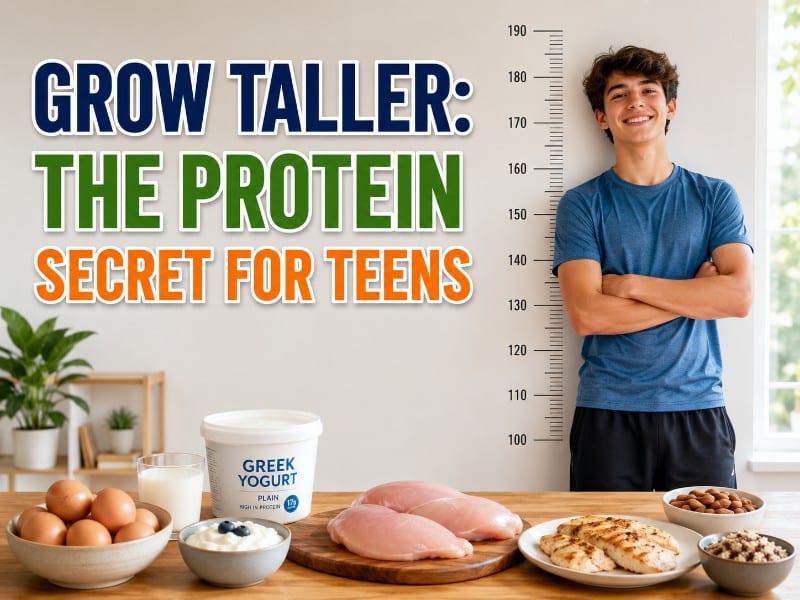
For busy teens, Greek yogurt with granola, hard-boiled eggs, or peanut butter on whole grain bread are practical high-protein snacks that don’t require much effort or prep time.
How Much Protein Do Teenagers Need Each Day?
The Recommended Dietary Allowance (RDA) from the USDA’s Dietary Guidelines for Americans sets protein needs at roughly 0.85 grams per kilogram of body weight per day for adolescents. In practical terms, that works out to about 46g daily for teenage girls and 52g for teenage boys.
Athletes, however, need more — sometimes significantly more.
| Group | Approximate Daily Protein Need |
|---|---|
| Teen girls (non-athlete, 14–18) | 46g |
| Teen boys (non-athlete, 14–18) | 52g |
| Teen girl athletes | 70–100g (varies by sport and intensity) |
| Teen boy athletes | 85–120g (varies by sport and intensity) |
What’s worth noting here: most teens in the U.S. already meet the baseline RDA through typical eating. The real gap tends to show up in teens skipping meals, following highly restrictive diets, or relying on low-protein processed foods throughout the day.
A Registered Dietitian can give personalized recommendations, especially for teens in high-demand sports like wrestling, swimming, or track. Protein distribution also matters — spreading intake across meals tends to support better protein synthesis than eating most of it in one sitting.
Other Nutrients That Support Height Growth
Protein doesn’t work in isolation. Height growth during puberty depends on a cluster of nutrients working in coordination.
Calcium is arguably the most important partner. Bone mineralization — the process that gives bones their hardness and density — requires calcium as its primary raw material. The American Academy of Pediatrics (AAP) recommends 1,300mg of calcium per day for teens aged 9 to 18. Dairy products, fortified plant milks, and leafy greens are solid sources.
Vitamin D enables calcium absorption. Without adequate vitamin D, much of the calcium a teen consumes simply doesn’t get absorbed efficiently. The Centers for Disease Control and Prevention (CDC) notes that vitamin D deficiency is common among U.S. adolescents, particularly in northern states with limited sun exposure during winter months.
Zinc plays a quieter but important role in cell division and growth hormone regulation. Research links zinc deficiency to delayed puberty and reduced linear growth. Magnesium supports bone density and muscle function, often overlooked but genuinely relevant for skeletal strength.
Lifestyle Habits That Influence Height Growth
Nutrition is only part of the equation. Sleep is where a lot of the actual growth happens.
HGH is released in pulses during deep sleep — specifically during slow-wave sleep stages. The Sleep Foundation notes that teenagers need 8 to 10 hours of sleep per night, yet most get significantly less than that. Chronic sleep deprivation doesn’t just cause fatigue; it suppresses the hormonal activity that drives physical development.
Physical activity, particularly weight-bearing exercise and sports like basketball, supports bone density and stimulates HGH release. Strength training, when done correctly and age-appropriately, doesn’t stunt growth — that’s an old myth. In practice, it tends to support skeletal development when paired with adequate nutrition.
Managing stress matters more than people realize. Chronic stress elevates cortisol, which can suppress growth hormone production over time. Recovery — actual downtime between physical and academic demands — is part of the growth environment.
Common Mistakes Parents and Teens Make
A few patterns tend to show up repeatedly, and most of them are avoidable.
Relying on protein supplements instead of food. Protein powders and bars aren’t harmful in moderation, but they’re frequently used as replacements rather than supplements. Whole food sources provide amino acids alongside micronutrients, fiber, and other compounds that supplements simply don’t replicate. A pediatrician’s input is useful before teens start any regular supplement routine.
Skipping meals, especially breakfast. Meal timing affects protein synthesis. Spreading protein across three meals generally outperforms consuming most of it at dinner. Teens who skip breakfast or eat very little during the school day create a real gap in their daily nutritional balance.
Trusting TikTok nutrition trends over actual evidence. Some of the most widely shared height growth “hacks” circulating on social media have no meaningful scientific backing. Stretching routines, specific “growth foods,” and energy drinks marketed toward athletes often distract from the basics that actually work.
Loading up on empty calories. Fast food consumed daily as a dietary staple crowds out nutrient-rich options. It’s not about occasional indulgence — it’s about what fills the majority of a teen’s plate across the week.
Final Thoughts
Protein genuinely matters for teenage height growth — not as a magic lever, but as an essential structural input that the body depends on during one of its most demanding developmental phases. Getting enough complete protein, pairing it with calcium and vitamin D, sleeping consistently, and staying active creates the conditions where a teen’s genetic height potential can actually be reached.
The practical takeaway: focus on building a varied, protein-adequate diet from whole food sources, take sleep seriously, and skip the supplements that promise results beyond what biology actually permits. A conversation with a Registered Dietitian or pediatrician can always help tailor recommendations to your teen’s specific needs, activity level, and growth stage.
Cardiologist and researcher with over a decade of clinical experience in heart disease prevention and cardiovascular risk reduction.
Research dietitian and nutrition scientist focused on evidence-based dietary interventions for chronic metabolic conditions.

Frequently Asked Questions
A lot of people assume piling on protein magically adds inches. It’s not that simple. What I’ve noticed, especially with active teens, is that protein mainly supports the stuff happening behind the scenes — bone development, muscle growth, tissue repair. Your body uses it constantly during growth spurts. But honestly, getting enough matters way more than overdoing it.
In practice, foods like eggs, Greek yogurt, fish, chicken, milk, tofu, and beans usually work well because they deliver complete amino acids plus nutrients your body quietly relies on.
It’s surprisingly uneven. Girls often finish growing between 14 and 16, while boys can keep going until 18 or so. Growth plates closing — that’s usually the deciding factor.
Most healthy teens tolerate whey protein fine in moderate amounts, especially if sports are involved. I’d still lean toward products tested by third parties. Some cheap powders feel… questionable.
Not really. Shakes help fill gaps, but whole foods bring fiber, vitamins, minerals — the stuff you notice missing after a while.
References
- Centers for Disease Control and Prevention (CDC)Scholarly Article
- Dietary Guidelines for Americans, USDAScholarly Article
- National Institutes of Health (NIH) Growth ResearchScholarly Article
- NIH Studies on Protein Intake and Bone DevelopmentScholarly Article
- FDA Dietary Supplement GuidanceScholarly Article
- NIH Genetics and Height ResearchScholarly Article