- 1.Key Takeaways
- 2.How Food Actually Influences Height
- 3.Protein: The Most Underestimated Growth Nutrient
- 4.Calcium: Foundation of Bone Length and Density
- 5.Vitamin D: The Absorption Multiplier
- 6.Zinc and Magnesium: The Quiet Deficiencies
- 7.Fruits and Vegetables: The Overlooked Category
- 8.Foods That Work Against Growth
- 9.Sleep and Exercise: What Amplifies Everything Above
- 10.Final Thoughts
There’s usually a moment when height becomes something you start paying attention to. A school photo where your kid looks shorter than their classmates. A growth chart that’s flattened out. A teenager wondering if they’ve hit their ceiling.
The honest answer is that most of height is genetic — roughly 80%, according to Silventoinen (2003). But “mostly genetic” doesn’t mean food is irrelevant. It means the 20% that isn’t genetic is worth taking seriously — and nutrition sits right at the center of that 20%.
What you eat doesn’t add inches beyond your genetic ceiling. What it can do is make sure your body actually reaches that ceiling, rather than stopping short because it ran low on something it needed during a critical window.
Key Takeaways
- Genetics set the ceiling. Nutrition determines how close you get to it.
- Protein, calcium, vitamin D, and zinc each play distinct roles in bone and growth hormone function
- The most important growth windows are roughly ages 10–20 — but food quality matters throughout childhood
- Most American diets run short on magnesium and zinc, two minerals that affect growth hormone production
- Sleep and physical activity determine how efficiently nutrients get used — diet alone doesn’t do it
How Food Actually Influences Height
Growth isn’t just “happening” while a kid eats whatever’s around. It’s a construction process, and food is the material.
Specifically, nutrition fuels bone elongation at the growth plates, supports cartilage health, and helps regulate human growth hormone (HGH) output. Each of those processes has different nutritional requirements — and deficits in any one of them can limit the final result. (Perkins et al., 2016)
Growth also doesn’t pace itself evenly. Puberty concentrates a lot of linear bone growth into a compressed period. If the raw materials aren’t available during that window, the body doesn’t really go back and make it up — it keeps moving. That’s the part most people don’t fully account for.
Protein: The Most Underestimated Growth Nutrient
Protein might be the nutrient most people mentally file under “gym stuff,” which misses what it’s actually doing during growth phases.
Your bones are built on a protein scaffold before minerals like calcium even enter the picture. Without adequate protein and height growth, bone matrix formation slows — and so does muscle development, which supports the structural load of a longer frame. (Perkins et al., 2016)
Good protein sources for growing teens:
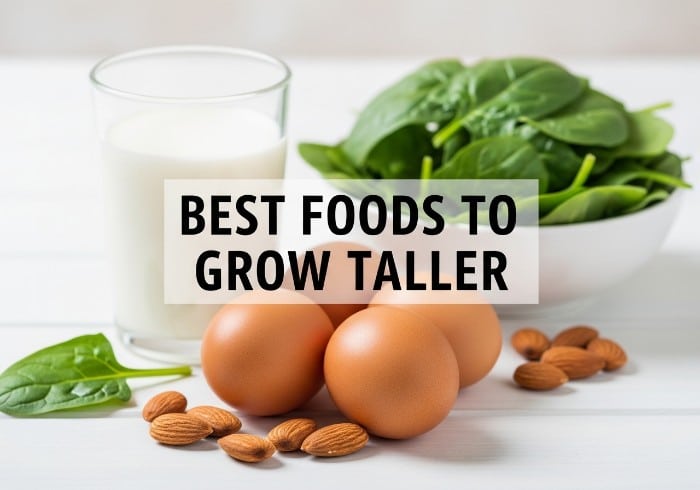
- Eggs (one of the few complete proteins with all 9 essential amino acids)
- Chicken breast, turkey
- Greek yogurt, milk
- Lentils, chickpeas, quinoa for plant-based options
A rough daily target during growth phases: 0.8–1.2 grams per kilogram of body weight, spread across 3–4 meals rather than loaded into one. Total calorie intake matters too — even solid protein numbers don’t fully compensate if the body is running on too little fuel overall.
Calcium: Foundation of Bone Length and Density
Calcium is the one everyone knows about, and the attention is warranted. It’s the primary mineral in bone tissue, and it contributes to both length and density during the growing years. (CDC NCHS)
The part that gets missed: calcium doesn’t work on its own. Drinking milk every day and still falling short on bone health is more common than people expect, usually because absorption is the missing piece — not intake.
Calcium-rich foods:
- Milk, cheese, yogurt
- Kale, spinach, bok choy
- Fortified cereals and plant-based milks
Daily Calcium Targets (NIH Guidelines)
| Age Group | Recommended Daily Intake |
|---|---|
| 9–18 years | 1,300 mg/day |
| 19–25 years | 1,000 mg/day |
Hitting those numbers consistently — not just occasionally — is where it actually matters. Missing calcium intake for several weeks during a growth phase isn’t something the body easily offsets later.
Vitamin D: The Absorption Multiplier
This is often where otherwise decent diets quietly fall apart.
Vitamin D increases calcium absorption by roughly 30–40%, which makes it a direct factor in how effective your calcium intake is. Without enough of it, a solid dairy habit does less work than it should. (PMC)
Main sources:
- Sunlight — around 10–30 minutes daily, varying by skin tone and location
- Fatty fish: salmon, tuna, mackerel
- Fortified foods: many cereals, dairy products, orange juice
If your family is in a northern state or spends most of the day indoors — which covers a lot of people — vitamin D deficiency is more common than the word “deficiency” implies. Lab results come back low in people who’d describe their diet as perfectly healthy. Winter months cut natural production significantly. When sun exposure drops, diet has to pick up the slack, and it often doesn’t.
Vitamin D is worth checking vitamins for height growth to understand the full picture, including how supplementation fits in.
Zinc and Magnesium: The Quiet Deficiencies
These two don’t get much attention, which is roughly the opposite of how much they matter.
Zinc is involved in growth hormone production and protein synthesis. Magnesium supports bone density and muscle function. During puberty, the body’s demand for both climbs sharply — and most American diets don’t keep pace. (Kim & Keen, 2021)
Zinc-rich foods: pumpkin seeds, beef, chickpeas, cashews
Magnesium sources: almonds, spinach, black beans, whole grains
The tricky thing about zinc deficiency is that it doesn’t announce itself loudly. Intake can be consistently low for months before someone notices the pattern. Even a slight dip in zinc is enough to affect hormone output in ways that quietly steer growth in the wrong direction.
Fruits and Vegetables: The Overlooked Category
Most people don’t immediately connect produce to height. That’s understandable — the link isn’t obvious. But fruits and vegetables deliver vitamin C, antioxidants, and fiber, all of which support tissue repair and bone development in ways that add up.
Vitamin C specifically plays a role in collagen synthesis — and collagen is structural material in bone, not just skin. (Perkins et al., 2016)
Worth including regularly:
- Oranges, kiwi, strawberries (vitamin C)
- Broccoli, carrots, bell peppers (bone-supporting antioxidants)
- Seasonal produce where available — fresher often means better nutrient retention
Frequency matters more than variety, at least in practice. Broccoli twice a week does more than a big salad once a month.
Foods That Work Against Growth
This is the section that tends to get skipped, but probably shouldn’t.
Highly processed foods that help you grow taller are largely defined by what they’re missing, not just what they contain. Fast food, sugary drinks, and high-caffeine beverages can interfere with calcium absorption and hormone balance in ways that accumulate over time. (Kim & Keen, 2021)
One fast food meal doesn’t move the needle. But in the U.S., fast food isn’t just occasional for a lot of families — it’s the default. The shift from “sometimes” to “most nights” tends to happen gradually, and by the time it’s noticed, the habit is already built.
There’s more detail on specific foods in does sugar stunt growth and does coffee stunt your growth.
Sleep and Exercise: What Amplifies Everything Above
Solid nutrition and poor sleep is a combination that underperforms. Growth hormone is mostly released during deep sleep — not a steady background trickle, but real pulses concentrated in the early hours after falling asleep. (Shaw et al., 2023)
For teens: 8–10 hours, per CDC guidance. Total hours matter, but so does timing — staying up late and sleeping in shifts the depth of those early sleep cycles.
Physical activity matters too. Does swimming increase height, does basketball make you taller — these are popular questions, and the honest answer is that specific sports don’t add inches. But weight-bearing and stretching activities do support bone density and posture, and they amplify how effectively nutrients are used. (Exercise bone meta, 2025)
Growth happens during recovery, not during the activity itself. That part is easy to underestimate.
Final Thoughts
How close someone gets to their genetic height potential depends on a combination of factors — nutrient-dense food, consistent habits, and a lifestyle that works with the body’s biology during the windows when growth is actually happening.
That’s the part worth emphasizing: the windows. The average height for kids and average height for teenagers data reflects decades of real variation in exactly these patterns — not just genetics playing out, but nutrition and environment shaping where people land within their genetic range.
Small, consistent improvements tend to do more than dramatic overhauls that don’t last. And for anyone still in a growth window, daily food choices are shaping more than they probably seem to in the moment
Cardiologist and researcher with over a decade of clinical experience in heart disease prevention and cardiovascular risk reduction.